


Page 331 - MARSIUM'21 COMP OF PAPER
P. 331
Jamy Ong & Adaviah (2022)


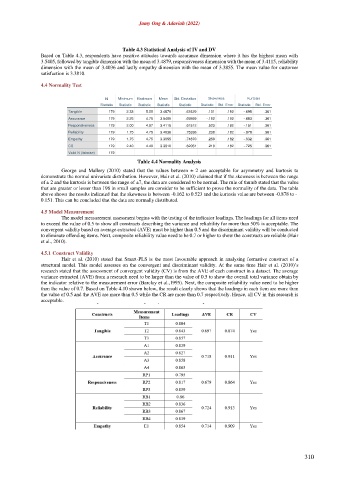
                                            Table 4.3 Statistical Analysis of IV and DV
               Based on Table 4.3, respondents have positive attitudes towards assurance dimension where it has the highest mean with
               3.5405, followed by tangible dimension with the mean of 3.4879, responsiveness dimension with the mean of 3.4115, reliability
               dimension with the mean of 3.4036 and lastly empathy dimension with the mean of 3.3855. The mean value for customer
               satisfaction is 3.3810.

               4.4 Normality Test

                                      N   Minimum  Maximum   Mean   Std. Deviation   Skewness   Kurtosis
                                    Statistic   Statistic   Statistic   Statistic   Statistic   Statistic   Std. Error   Statistic   Std. Error
                         Tangible      179   2.33   5.00   3.4879   .63429   .101   .182   -.695   .361
                         Assurance     179   2.25   4.75   3.5405   .69869   -.162   .182   -.683   .361
                         Responsiveness   179   2.00   4.67   3.4115   .61512   .523   .182   -.151   .361
                         Reliability   179   1.75   4.75   3.4036   .75336   .238   .182   -.878   .361
                         Empathy       179   1.75   4.75   3.3855   .74870   .259   .182   -.832   .361
                         CS            179   2.40   4.40   3.3810   .62051   .219   .182   -.725   .361
                         Valid N (listwise)   179
                                                 Table 4.4 Normality Analysis
                       George  and  Mallery  (2010)  stated  that  the  values  between  ±  2  are  acceptable  for  asymmetry  and  kurtosis  to
               demonstrate the normal univariate distribution. However, Hair et al. (2010) claimed that if the skewness is between the range
               of ± 2 and the kurtosis is between the range of ±7, the data are considered to be normal. The rule of thumb stated that the value
               that are greater or lesser than 196 in small samples are consider to be sufficient to prove the normality of the data. The table
               above shows the results indicated that the skewness is between -0.162 to 0.523 and the kurtosis value are between -0.878 to -
               0.151. This can be concluded that the data are normally distributed.

               4.5 Model Measurement
                       The model measurement assessment begins with the testing of the indicator loadings. The loadings for all items need
               to exceed the value of 0.5 to show all constructs describing the variance and reliability for more than 50% is acceptable. The
               convergent validity based on average extracted (AVE) must be higher than 0.5 and the discriminant validity will be conducted
               to eliminate offending items. Next, composite reliability value need to be 0.7 or higher to show the constructs are reliable (Hair
               et al., 2010).

               4.5.1 Construct Validity
                       Hair  et  al. (2010) stated that Smart-PLS is the most favourable approach in analysing formative construct of a
               structural model. This model assesses on the  convergent and discriminant validity. At the same time Hair et al. (2010)’s
               research stated that the assessment of convergent validity (CV) is from the AVE of each construct in a dataset. The average
               variance extracted (AVE) from a research need to be larger than the value of 0.5 to show the overall total variance obtain by
               the indicator relative to the measurement error (Barclay et al.,1995). Next, the composite reliability value need to be higher
               than the value of 0.7. Based on Table 4.10 shown below, the result clearly shows that the loadings in each item are more than
               the value of 0.5 and the AVE are more than 0.5 while the CR are more than 0.7 respectively. Hence, all CV in this research is
               acceptable.


                                                                                                            310

