


Page 328 - MARSIUM'21 COMP OF PAPER
P. 328
Jamy Ong & Adaviah (2022)


               score the degree of satisfaction with a variety of service quality dimension. Crompton et al. (1991) expressed that there was a
               lot of ambiguity in the satisfaction and service quality literature as researcher supposed to evaluate satisfaction  instead of
               evaluating service quality. Thus, researcher begin investigating the relationship of service quality towards customer satisfaction
               and both entities were separated into dependent and independent variable of a research (Tian-Cole, Crompton, & Wilson,
               2002).

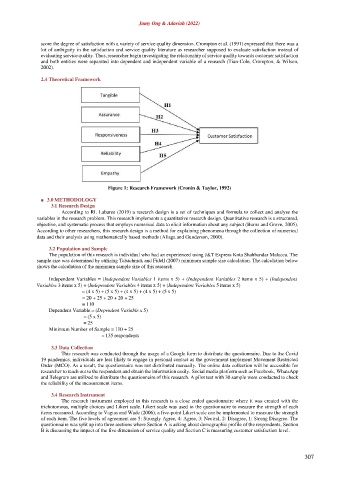
               2.4 Theoretical Framework


                                       Figure 1: Research Framework (Cronin & Taylor, 1992)

               ■  3.0 METHODOLOGY
                   3.1 Research Design
                       According to RL Labaree (2019) a research design is a set of techniques and formula to collect and analyse the
              variables in the research problem. This research implements a quantitative research design. Quantitative research is a structured,
              objective, and systematic process that employs numerical data to elicit information about any subject (Burns and Grove, 2005).
              According to other researchers, this research design is a method for explaining phenomena through the collection of numerical
              data and their analysis using mathematically based methods (Aliaga and Gunderson, 2000).

                  3.2 Population and Sample
                  The population of this research is individual who had an experienced using J&T Express Kota Shahbandar Malacca. The
              sample size was determined by utilizing Tabachnick and Fidell (2007) minimum sample size calculation. The calculation below
              shows the calculation of the minimum sample size of this research.

                  Independent  Variables = (Independent Variables 1 items x 5) + (Independent  Variables  2 items x 5) + (Independent
              Variables 3 items x 5) + (Independent Variables 4 items x 5) + (Independent Variables 5 items x 5)
                              = (4 x 5) + (5 x 5) + (4 x 5) + (4 x 5) + (5 x 5)
                              = 20 + 25 + 20 + 20 + 25
                              = 110
                  Dependent Variable = (Dependent Variable x 5)
                              = (5 x 5)
                              = 25
                  Minimum Number of Sample = 110 + 25
                                     = 135 respondents

                   3.3 Data Collection
                       This research was conducted through the usage of a Google form to distribute the questionnaire. Due to the Covid
               19 pandemics, individuals are less likely to engage in personal contact as the government implement Movement Restricted
               Order (MCO). As a result, the questionnaire was not distributed manually. The online data collection will be accessible for
               researcher to reach out to the respondent and obtain the information easily. Social media platform such as Facebook, WhatsApp
               and Telegram are utilized to distribute the questionnaire of this research. A pilot test with 30 sample were conducted to check
               the reliability of the measurement items.

                   3.4 Research Instrument
                       The research instrument employed in this research is a close ended questionnaire where it was created with the
               trichotomous, multiple choices and Likert scale. Likert scale was used in the questionnaire to measure the strength of each
               items measured. According to Vagias and Wade (2006), a five-point Likert scale can be implemented to measure the strength
               of each item. The five levels of agreement are 5: Strongly Agree, 4: Agree, 3: Neutral, 2: Disagree, 1: Strong Disagree. The
               questionnaire was split up into three sections where Section A is asking about demographic profile of the respondents, Section
               B is discussing the impact of the five dimension of service quality and Section C is measuring customer satisfaction level.


                                                                                                            307

