


Page 344 - MARSIUM'21 COMP OF PAPER
P. 344
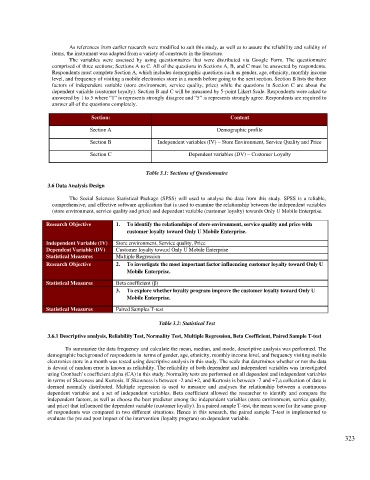
As references from earlier research were modified to suit this study, as well as to assure the reliability and validity of
                  items, the instrument was adapted from a variety of constructs in the literature.
                        The  variables  were  assessed  by  using  questionnaires  that  were  distributed  via  Google  Form.  The  questionnaire
                  comprised of three sections; Sections A to C. All of the questions in Sections A, B, and C must be answered by respondents.
                  Respondents must complete Section A, which includes demographic questions such as gender, age, ethnicity, monthly income
                  level, and frequency of visiting a mobile electronics store in a month before going to the next section. Section B lists the three
                  factors of independent variable (store environment, service quality, price) while the questions in Section C are about  the
                  dependent variable (customer loyalty). Section B and C will be measured by 5-point Likert Scale. Respondents were asked to
                  answered by 1 to 5 where “1” is represents strongly disagree and “5” is represents strongly agree. Respondents are required to
                  answer all of the questions completely.

                               Section:                                      Content
                               Section A                                 Demographic profile

                               Section B             Independent variables (IV) – Store Environment, Service Quality and Price
                               Section C                       Dependent variables (DV) – Customer Loyalty


                                                 Table 3.1: Sections of Questionnaire

                 3.6 Data Analysis Design

                        The Social Sciences Statistical Package (SPSS) will used to analyse the data from this study. SPSS is a reliable,
                  comprehensive, and effective software application that is used to examine the relationship between the independent variables
                  (store environment, service quality and price) and dependent variable (customer loyalty) towards Only U Mobile Enterprise.

                Research Objective     1.   To identify the relationships of store environment, service quality and price with
                                           customer loyalty toward Only U Mobile Enterprise.

                Independent Variable (IV)   Store environment, Service quality, Price
                Dependent Variable (DV)   Customer loyalty toward Only U Mobile Enterprise
                Statistical Measures   Multiple Regression
                Research Objective     2.   To investigate the most important factor influencing customer loyalty toward Only U
                                           Mobile Enterprise.

                Statistical Measures   Beta coefficient (β)
                                       3.   To explore whether loyalty program improve the customer loyalty toward Only U
                                           Mobile Enterprise.
                Statistical Measures   Paired Samples T-test

                                                      Table 3.2: Statistical Test

                 3.6.1 Descriptive analysis, Reliability Test, Normality Test, Multiple Regression, Beta Coefficient, Paired Sample T-test

                       To summarize the data frequency and calculate the mean, median, and mode, descriptive analysis was performed. The
                 demographic background of respondents in  terms of gender, age, ethnicity, monthly income level, and frequency visiting mobile
                 electronics store in a month was tested using descriptive analysis in this study. The scale that determines whether or not the data
                 is devoid of random error is known as reliability. The reliability of both dependent and independent variables was investigated
                 using Cronbach’s coefficient alpha (CA) in this study. Normality tests are performed on all dependent and independent variables
                 in terms of Skewness and Kurtosis. If Skewness is between -2 and +2, and Kurtosis is between -7 and +7, a collection of data is
                 deemed  normally  distributed.  Multiple  regression  is  used  to  measure  and  analyses  the  relationship  between  a  continuous
                 dependent variable and a set  of independent variables. Beta coefficient  allowed the researcher to identify  and compare the
                 independent factors, as well as choose the best predictor among the independent variables (store environment, service quality,
                 and price) that influenced the dependent variable (customer loyalty). In a paired sample T-test, the mean score for the same group
                 of respondents was compared in two different situations. Hence in this research, the paired sample T-test is implemented to
                 evaluate the pre and post impact of the intervention (loyalty program) on dependent variable.


                                                                                                                   323

