


Page 384 - MARSIUM'21 COMP OF PAPER
P. 384
363                                        Leon (2021)
            4.1 Multiple Regression Analysis

            Multiple Regression is a statistical method used to analyse the relationship between a single dependent variable and several independent
            variables. Multiple regression  analysis was performed in this study in order to find out which is the strongest  predictor that motivates
            visitor intention to visit at Nancy’s Kitchen, looked into the beta coefficient value and the largest value was the most influential variable
            for this group according to Julie Pallant (2007).

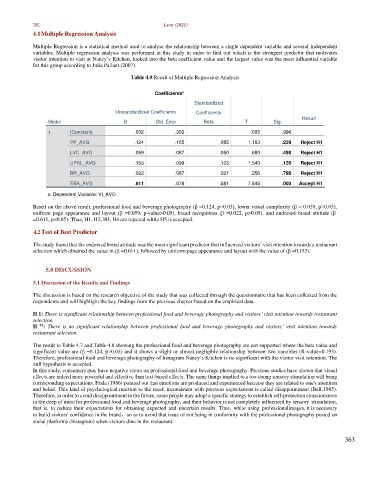
                                            Table 4.9 Result of Multiple Regression Analysis

                                                             a
                                                    Coefficients

                                                                 Standardized
                                       Unstandardized Coefficients   Coefficients
                                                                                                     Result
                 Model                    B          Std. Error     Beta          T        Sig.

                 1      (Constant)           .002          .302                     .005      .996
                        PP_AVG               .124          .105           .085     1.183      .239   Reject H1
                        LVC_AVG              .059          .087           .050      .680      .498   Reject H1
                        UPAL_AVG             .153          .099           .123     1.540      .126   Reject H1
                        BR_AVG               .022          .087           .021      .256      .798   Reject H1
                        EBA_AVG              .611          .078           .581     7.845      .000   Accept H1

                 a. Dependent Variable: VI_AVG

            Based on the above result, professional food and beverage photography (β =0.124, p>0.05), lower visual complexity (β = 0.059, p>0.05),
            uniform  page  appearance  and  layout  (β  =0.059, p-value>0.05), brand  recognition  (β  =0.022,  p>0.05),  and  endorsed  brand  attitude  (β
            =0.611, p<0.05). Thus, H1, H2, H3, H4 are rejected while H5 is accepted.

            4.2 Test of Best Predictor

            The study found that the endorsed brand attitude was the most significant predictor that influenced visitors’ visit intention towards a restaurant
            selection which obtained the value in (β =0.611), followed by uniform page appearance and layout with the value of (β =0.153).


                 5.0 DISCUSSION

            5.1 Discussion of the Results and Findings

            The discussion is based on the research objective of the study that was collected through the questionnaire that has been collected from the
            respondents and will highlight the key findings from the previous chapter based on the empirical data.

            H 1: There is significant relationship between professional food and beverage photography and visitors’ visit intention towards restaurant
            selection.
              01
            H  :  There  is  no  significant  relationship  between  professional  food  and  beverage  photography  and  visitors’  visit  intention  towards
            restaurant selection.

            The result in Table 4.7 and Table 4.8 showing the professional food and beverage photography are not supported where the beta value and
            significant value are (β =0.124, p>0.05) and it shows a slight or almost negligible relationship between two variables (R-value=0.193).
            Therefore, professional food and beverage photography of Instagram Nancy’s Kitchen is no significant with the visitor visit intention. The
            null hypothesis is accepted.
            In this study, consumers may have negative views on professional food and beverage photography. Previous studies have shown that visual
            effects are indeed more powerful and effective than text-based effects. The same things implied to a too strong sensory stimulation will bring
            corresponding expectations. Frida (1986) pointed out that emotions are produced and experienced because they are related to one's attention
            and belief. This kind of psychological reaction to the result inconsistent with previous expectations is called disappointment (Bell, 1985).
            Therefore, in order to avoid disappointment in the future, some people may adopt a specific strategy to establish self-protection consciousness
            in the deep of mind for professional food and beverage photography, and their behavior is not completely influenced by sensory stimulation,
            that  is,  to  reduce  their  expectations  for  obtaining  expected  and  uncertain  results.  Thus,  while  using  professional images, it is necessary
            to build visitors' confidence in the brand,so as to avoid that issue of not being in conformity with the professional photography posted on
            social platforms (Instagram) when visitors dine in the restaurant.


                                                                                                                   363

