


Page 531 - MARSIUM'21 COMP OF PAPER
P. 531
a. Predictors: (Constant), Food Quality, Service Quality, Physical Environment, Customer Perceive Value.


            4.6 Summary of Hypothesis

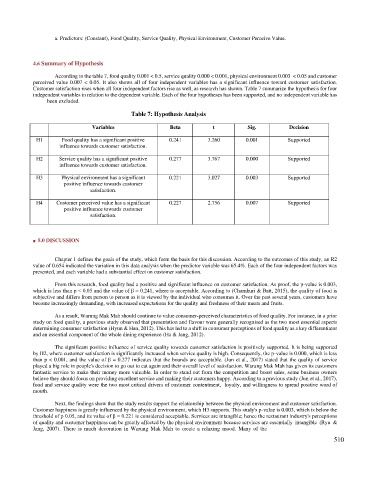
                   According to the table 7, food quality 0.001 < 0.5, service quality 0.000 < 0.001, physical environment 0.003  < 0.05 and customer
            perceived value 0.007 < 0.05. It also shows all of four independent variables has a significant influence toward customer satisfaction.
            Customer satisfaction rises when all four independent factors rise as well, as research has shown. Table 7 summarize the hypothesis for four
            independent variables in relation to the dependent variable. Each of the four hypotheses has been supported, and no independent variable has
                 been excluded.

                                            Table 7: Hypothesis Analysis

                               Variables                 Beta          t           Sig.          Decision
             H1      Food quality has a significant positive   0.241   3.260      0.001         Supported
                     influence towards customer satisfaction.
             H2      Service quality has a significant positive   0.277   3.767   0.000         Supported
                     influence towards customer satisfaction.

             H3      Physical environment has a significant   0.221   3.027       0.003         Supported
                      positive influence towards customer
                               satisfaction.
             H4     Customer perceived value has a significant   0.227   2.756    0.007         Supported
                      positive influence towards customer
                               satisfaction.


            ■  5.0 DISCUSSION


                   Chapter 1 defines the goals of the study, which form the basis for this discussion. According to the outcomes of this study, an R2
            value of 0.654 indicated the variation in this data analysis when the predictor variable was 65.4%. Each of the four independent factors was
            presented, and each variable had a substantial effect on customer satisfaction.

                   From this research, food quality had a positive and significant influence on customer satisfaction. As proof, the p-value is 0.003,
            which is less than p < 0.05 and the value of β = 0.241, where is acceptable. According to (Chamhuri & Batt, 2015), the quality of food is
            subjective and differs from person to person as it is viewed by the individual who consumes it. Over the past several years, customers have
            become increasingly demanding, with increased expectations for the quality and freshness of their meats and fruits.

                   As a result, Warung Mak Mah should continue to value consumer-perceived characteristics of food quality. For instance, in a prior
            study on food quality, a previous study observed that presentation and flavour were generally recognised as the two most essential aspects
            determining consumer satisfaction (Hyun & Han, 2012). This has led to a shift in consumer perceptions of food quality as a key differentiator
            and an essential component of the whole dining experience (Ha & Jang, 2012).

                   The significant positive influence of service quality towards customer satisfaction is positively supported. It is being supported
            by H2, where customer satisfaction is significantly increased when service quality is high. Consequently, the p-value is 0.000, which is less
            than p < 0.001, and the value of β = 0.277 indicates that the bounds are acceptable. (Jun et al., 2017) stated that the quality of service
            played a big role in people's decision to go out to eat again and their overall level of satisfaction. Warung Mak Mah has given its customers
            fantastic service to make their money more valuable. In order to stand out from the competition and boost sales, some business owners
            believe they should focus on providing excellent service and making their customers happy. According to a previous study (Jun et al., 2017),
            food and service quality were the two most critical drivers of customer contentment,  loyalty, and willingness to spread positive word of
            mouth.

                   Next, the findings show that the study results support the relationship between the physical environment and customer satisfaction.
            Customer happiness is greatly influenced by the physical environment, which H3 supports. This study's p-value is 0.003, which is below the
            threshold of p 0.05, and its value of β = 0.221 is considered acceptable. Services are intangible; hence the restaurant industry's perceptions
            of quality and customer happiness can be greatly affected by the physical environment because services are essentially  intangible  (Ryu  &
            Jang,  2007).  There  is  much  decoration  in  Warung  Mak  Mah  to  create  a  relaxing  mood.  Many  of  the
                                                                                                                510

