


Page 584 - MARSIUM'21 COMP OF PAPER
P. 584
563                                        Najihah & Mazilah (2022)

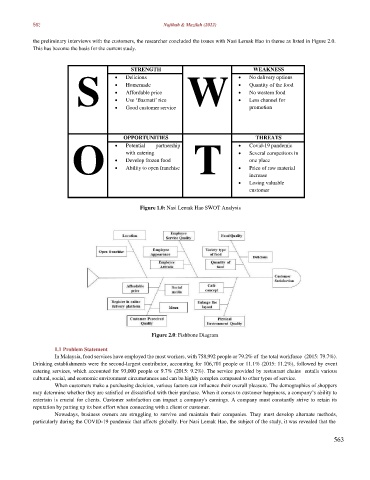
            the preliminary interviews with the customers, the researcher concluded the issues with Nasi Lemak Hao in theme as listed in Figure 2.0.
            This has become the basis for the current study.

                                            STRENGTH                                 WEAKNESS
                          S            •   Delicious           W                •   No delivery options

                                       •
                                                                                    Quantity of the food
                                           Homemade
                                                                                •
                                       •
                                                                                •
                                                                                    No western food
                                           Affordable price
                                       •
                                                                                    promotion
                                           Good customer service
                                       •   Use ‘Basmati’ rice                   •   Less channel for
                                                                                      THREATS
                         O             •   OPPORTUNITIES         T              •   Covid-19 pandemic
                                           Potential
                                                     partnership
                                                                                    Several competitors in
                                                                                •
                                           with catering
                                           Develop frozen food
                                                                                    one place
                                       •
                                                                                    Price of raw material
                                                                                •
                                           Ability to open franchise
                                       •
                                                                                •   increase
                                                                                    Losing valuable
                                                                                    customer

                                               Figure 1.0: Nasi Lemak Hao SWOT Analysis


                                                   Figure 2.0: Fishbone Diagram

                   1.1 Problem Statement
                   In Malaysia, food services have employed the most workers, with 758,992 people or 79.2% of  the total workforce  (2015: 79.7%).
            Drinking establishments were the second-largest contributor, accounting for 106,701 people or 11.1% (2015: 11.2%), followed by event
            catering services, which accounted for 93,000 people or 9.7% (2015: 9.2%). The service provided by restaurant chains  entails various
            cultural, social, and economic environment circumstances and can be highly complex compared to other types of service.
                   When customers make a purchasing decision, various factors can influence their overall pleasure. The demographics of shoppers
            may determine whether they are satisfied or dissatisfied with their purchase. When it comes to customer happiness, a company’s ability to
            entertain is crucial for clients. Customer satisfaction can impact a company's earnings. A company must constantly strive to  retain its
            reputation by putting up its best effort when connecting with a client or customer.
                   Nowadays,  business  owners  are  struggling  to  survive  and  maintain  their  companies.  They  must  develop  alternate  methods,
            particularly during the COVID-19 pandemic that affects globally. For Nasi Lemak Hao, the subject of the study, it was revealed that the


                                                                                                               563

