


Page 588 - MARSIUM'21 COMP OF PAPER
P. 588
567                                        Najihah & Mazilah (2022)


                   3.2 Population and Sampling
                   The respondents to this survey are consumers of Nasi Lemak Hao. Furthermore, participants in this study must be made a previous
            purchase from Nasi Lemak Hao to be eligible for participation. This is because the researcher was only interested in Nasi Lemak Hao client
            satisfaction limiting its scope. The non-probability sampling technique, also known as purposive sampling, was selected and employed by
            the  researchers  for  this  study.  The  low  cost  per  completed  interview,  which  is  far  cheaper  than  even  low-cost  probabilistic  sampling
            approaches such as mail surveys or telephone surveys, makes non-probability sampling the favoured method of choice for researchers over
            probability sampling (Brick, 2014).
                   First, after answering a question to confirm that the respondent is indeed a customer of Nasi Lemak Hao, the respondent would
            be able to proceed with the survey. Cohen's table was used as a tool to calculate the sample size. The purpose of the study is to determine
            an acceptable sampling size to optimise rather than maximise sampling effort while working within the restrictions of time and money (Lee
            Chuan,  2006).  Increasing  sample  efforts  would  make  it  easier  to  avoid  data  storage  situations,  resulting  in  inconclusive  conclusions.
            According to Cohen's table, a sample size of 126 is required for five independent variables to be statistically significant. Other considerations,
            including respondents who did not return the questionnaire form and other constraints, have led to the researcher including just approximately
            10% of those who replied in this study. The significance of the study was determined via multiple regression analysis and the F test of
            multiple R2, with a p-value of less than 0.01.

                   3.3 Research Instrument
                   In this study, three-part structured questionnaires were used, with each section containing three questions. The first section contains
            information on the prospective respondent's demographic background. Sixteen components are covered in the second section, including the
            customer's experience with the meal quality, the employee's service quality, the physical environment quality, the customer's perceived
            quality, and the location. Finally, in the third section, respondents were  provided with a series of questions about client satisfaction. A
            nominal scale is used in the first section, and in the second and third sections, a Likert scale was used. Respondents were asked to fill out a
            Google Form, which was used to gather information. The researcher provided the Google form to the restaurant's owner, Nasi Lemak Hao,
            who then uploaded it to its WhatsApp status. According to the researcher, WhatsApp was used among other sites since it is easier to reach
            out to customers compared to other open platforms.
                   The researcher conducted preliminary testing prior to disseminating the survey questionnaire through a pilot study and pre-test.
            The current study conducted an academic expert validity to validate the items measurements. The expert was  chosen from the field of
            Marketing and Management (Dr Grace Thoo Ai Chin – UTM). The recommended pilot sample size of 30 individuals defaulted for the pre-
            testing phase of the study (Perneger et al., 2015). Immediately after completing the pre-testing phase, the researcher conducted the study.
            The goal is to evaluate whether the questions were valid based on their substance and face validity and the usability (including ease of access
            and navigation) utilised to administer the questionnaire (Fraser et al., 2018).

                   3.4 Data Analysis
                    The information gathered in this study was analysed using the Statistical Package for Social Science (SPSS) using Multiple
            Regression.  In  this  study,  the  demographics  of  the  respondents  were  analysed  using  percentages  and  frequencies.  The  statistical  tests
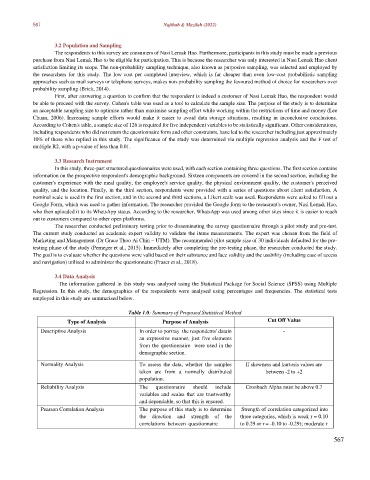
            employed in this study are summarised below.

                                            Table 1.0: Summary of Proposed Statistical Method
                       Type of Analysis                Purpose of Analysis                Cut Off Value
               Descriptive Analysis            In order to portray  the respondents' data in   -
                                               an expressive manner,  just five elements
                                               from the questionnaire  were used in the
                                               demographic section.
               Normality Analysis              To  assess  the  data,  whether  the  samples   If skewness and kurtosis values are
                                               taken  are  from  a  normally  distributed   between -2 to +2
                                               population.
               Reliability Analysis            The   questionnaire   should   include   Cronbach Alpha must be above 0.7
                                               variables  and  scales that  are  trustworthy
                                               and dependable, so that this is ensured.
               Pearson Correlation Analysis    The purpose of this study is to determine   Strength of correlation categorized into
                                               the  direction  and  strength  of  the   three categories, which is weak r = 0.10
                                               correlations  between  questionnaire   to 0.29 or r = -0.10 to -0.29); moderate r

                                                                                                               567

