


Page 591 - MARSIUM'21 COMP OF PAPER
P. 591
570                                        Najihah & Mazilah (2022)

                                       Minimum        Maximum           Mean         Std. Deviation      N
                    Mahal Distance      .314           14.172           4.960           2.874           126


                   4.6 Multicollinearity Analysis
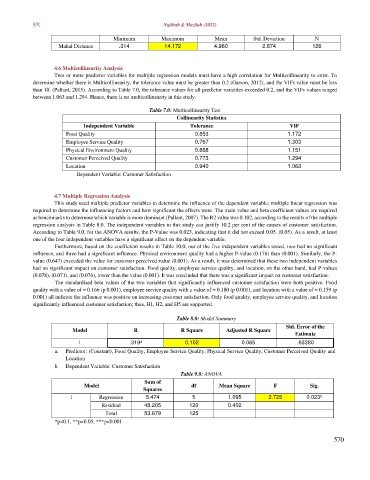
                   Two or more predictor variables for multiple regression models must have a high correlation for Multicollinearity to exist. To
            determine whether there is Multicollinearity, the tolerance value must be greater than 0.2 (Garson, 2012), and the VIFs value must be less
            than 10. (Pallant, 2015). According to Table 7.0, the tolerance values for all predictor variables exceeded 0.2, and the VIFs values ranged
            between 1.063 and 1.294. Hence, there is no multicollinearity in this study.

                                                  Table 7.0: Multicollinearity Test
                                                           Collinearity Statistics
                             Independent Variable               Tolerance                        VIF
                       Food Quality                               0.853                         1.172
                       Employee Service Quality                   0.767                         1.303
                       Physical Environment Quality               0.868                         1.151
                       Customer Perceived Quality                 0.773                         1.294
                       Location                                   0.940                         1.063
                          Dependent Variable: Customer Satisfaction


                   4.7 Multiple Regression Analysis
                   This study used multiple predictor variables to determine the influence of the dependent variable; multiple linear regression was
            required to determine the influencing factors and how significant the effects were. The main value and beta coefficient values are required
            as benchmarks to determine which variable is more dominant (Pallant, 2007). The R2 value was 0.102, according to the results of the multiple
            regression analysis in Table 8.0. The independent variables in this study can justify 10.2 per cent of the causes of customer satisfaction.
            According to Table 9.0, for the ANOVA results, the P-Value was 0.023, indicating that it did not exceed 0.05. (0.05). As a result, at least
            one of the four independent variables have a significant effect on the dependent variable.
                   Furthermore, based on the coefficient results in Table 10.0, out of the five independent variables tested, two had no significant
            influence, and three had a significant influence. Physical environment quality had a higher P-value (0.176) than (0.001). Similarly, the P-
            value (0.647) exceeded the value for customer perceived value (0.001). As a result, it was determined that these two independent variables
            had no significant impact on customer satisfaction. Food quality, employee service quality, and location, on the other hand, had P-values
            (0.078), (0.071), and (0.076), lower than the value (0.001). It was concluded that there was a significant impact on customer satisfaction.
                   The standardised beta values of the two variables that significantly influenced customer satisfaction were both positive. Food
            quality with a value of = 0.166 (p 0.001), employee service quality with a value of = 0.180 (p 0.001), and location with a value of = 0.159 (p
            0.001) all indicate the influence was positive on increasing customer satisfaction. Only food quality, employee service quality, and location
            significantly influenced customer satisfaction; thus, H1, H2, and H5 are supported.

                                                           Table 8.0: Model Summary
                                                                                                Std. Error of the
                         Model               R               R Square       Adjusted R Square
                                                                                                   Estimate
                           1                .319              0.102              0.065             .63380
                                               a
                   a.   Predictor: (Constant), Food Quality, Employee Service Quality, Physical Service Quality, Customer Perceived Quality and
                       Location
                   b.  Dependent Variable: Customer Satisfaction
                                                             Table 9.0: ANOVA
                                                 Sum of
                             Model                              df        Mean Square       F           Sig.
                                                Squares
                                                                                                           b
                        1         Regression     5.474           5          1.095         2.725       0.023
                                   Residual      48.205         120         0.402
                                    Total        53.679         125
                   *p<0.1, **p<0.05, ***p<0.001


                                                                                                               570

