


Page 592 - MARSIUM'21 COMP OF PAPER
P. 592
571                                        Najihah & Mazilah (2022)

                   a. Dependent Variable: Customer Satisfaction
                   c.   b. Predictors: (Constant), Food Quality, Employee Service Quality, Physical Service Quality, Customer Perceived Quality
                       and Location

                                                           Table 10.0: Coefficients
                                               Unstandardised Coefficients   Standardised
                             Model                                        Coefficients     t           Sig.
                                                   B         Std. Error     Beta
                          (Constant)          2.257        .497                       4.542        .000
                          Food Quality        .157         .088         .166          1.775        .078
                          Employee Service
                          Quality             .165         .090         .180          1.824        .071
                     1    Physical Environment
                          Quality             -.085        .062         -.126         -1.361       .176
                          Customer Perceived   .032        .069         .045          .459         .647
                          Quality
                          Location            .147         .082         .159          1.788        .076
                   *p<0.1, **p<0.05, ***p<0.001
                   a.  Dependent Variable: Customer Satisfaction

                   4.8 Hypothesis Testing
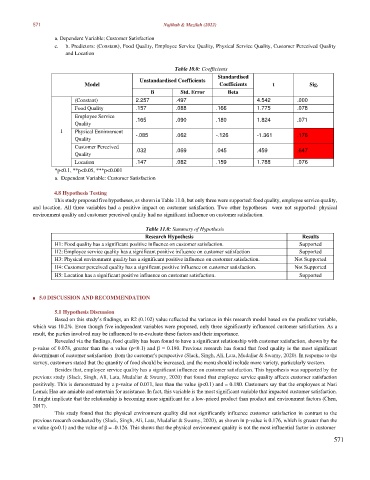
                   This study proposed five hypotheses, as shown in Table 11.0, but only three were supported: food quality, employee service quality,
            and  location.  All  three variables  had  a  positive impact  on  customer  satisfaction.  Two  other  hypotheses  were  not  supported:  physical
            environment quality and customer perceived quality had no significant influence on customer satisfaction.

                                                 Table 11.0: Summary of Hypothesis
                                                 Research Hypothesis                                 Results
                   H1: Food quality has a significant positive influence on customer satisfaction.   Supported
                   H2: Employee service quality has a significant positive influence on customer satisfaction   Supported
                   H3: Physical environment quality has a significant positive influence on customer satisfaction.   Not Supported
                   H4: Customer perceived quality has a significant positive influence on customer satisfaction.   Not Supported
                   H5: Location has a significant positive influence on customer satisfaction.      Supported


            ■  5.0 DISCUSSION AND RECOMMENDATION

                   5.1 Hypothesis Discussion
                   Based on this study’s findings, an R2 (0.102) value reflected the variance in this research model based on the predictor variable,
            which was 10.2%. Even though five independent variables were proposed, only three significantly influenced customer satisfaction. As a
            result, the parties involved may be influenced to re-evaluate these factors and their importance.
                   Revealed via the findings, food quality has been found to have a significant relationship with customer satisfaction, shown by the
            p-value of 0.078, greater than the α value (p<0.1) and β = 0.180. Previous research has found that food quality is the most significant
            determinant of customer satisfaction  from the customer's perspective (Slack, Singh, Ali, Lata, Mudaliar & Swamy, 2020). In response to the
            survey, customers stated that the quantity of food should be increased, and the menu should include more variety, particularly western.
                   Besides that, employee service quality has a significant influence on customer satisfaction. This hypothesis was supported by the
            previous study (Slack, Singh, Ali, Lata, Mudaliar & Swamy, 2020) that found that employee service quality affects customer satisfaction
            positively. This is demonstrated by a p-value of 0.071, less than the value (p<0.1) and = 0.180. Customers say that the employees at Nasi
            Lemak Hao are amiable and entertain for assistance. In fact, this variable is the most significant variable that impacted customer satisfaction.
            It might implicate that the relationship is becoming more significant for a low-priced product than product and environment factors (Chen,
            2017).
                   This study found that the physical environment quality did not significantly influence customer satisfaction in contrast to the
            previous research conducted by (Slack, Singh, Ali, Lata, Mudaliar & Swamy, 2020), as shown in p-value is 0.176, which is greater than the
            α value (p>0.1) and the value of β = -0.126. This shows that the physical environment quality is not the most influential factor in customer
                                                                                                               571

