


Page 660 - MARSIUM'21 COMP OF PAPER
P. 660
639                                         Syamimi (2022)


                 3.0 RESEARCH METHODOLOGY


               3.1 Research Design

               This  quantitative  study  evaluated  the  impact  of  publishing  pharmaceutical  products  on  Instagram  to  ensure  interactivity,
               consistency, and content type when consumers participate. Data were gathered by disseminating questionnaires via Google form
               to capture their perspectives on the factors that influenced their consumer’s engagement towards brand awareness of pharmaceutical
               products on Instagram. Respondents were asked to choose the best option of the Likert five-point scale from the list of items listed
               in the questionnaire. Likert's approval levels are: completely agree, agree, neutral, disagree, and completely disagree. Suppose the
               alternate items on the questionnaire are used for testing.


               3.2 Population and Sampling

               The process of sampling refers to the way in which a group of people is selected as a sample for the study. Design sampling is a
               method for picking a representative unit from the target population in order to collect information about that population. Due to the
               interaction of pharmaceutical accounts on Instagram, users of Instagram were selected as respondents for more accurate results.
               Therefore, 100 respondents were selected from the total population. Tabachnick and Dell were used in this sampling technique to
               obtain a sample that accurately represents the population.

                         Independent variables:          = (IV1 x 5) + (IV2 x 5) + (IV3 x 5)
                                                         = (5X5) + (5X5) + (5X5) = 75


                         Demographic:                    = 6 X 5 = 30


                         Minimum Number of Sample:       = (IV + Demographic)
                                                         = 70 + 30 = 105 respondents


               3.3 Research Instrument

               A collection of questions by using use a quantitative approach (Likert scale questions) was adapted from previous studies that were
               considered suitable and useful for this research. This study's questionnaire was divided into three components; Sections A, B and
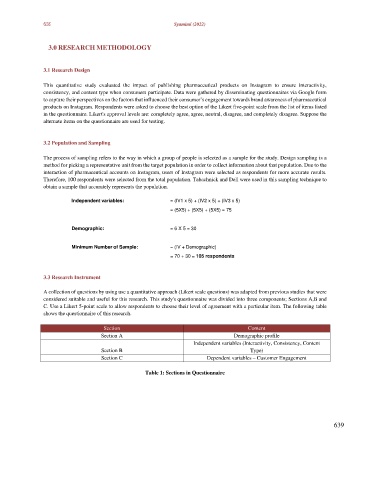
               C. Use a Likert 5-point scale to allow respondents to choose their level of agreement with a particular item. The following table
               shows the questionnaire of this research.

                                   Section                                         Content
                                  Section A                                   Demographic profile
                                                                 Independent variables (Interactivity, Consistency, Content
                                   Section B                                        Type)
                                   Section C                         Dependent variables – Customer Engagement

                                                 Table 1: Sections in Questionnaire


                                                                                                                639

