


Page 759 - MARSIUM'21 COMP OF PAPER
P. 759
738                                        Alya (2022)

            The population of a research represents a set of persons, items, or  people in general to whom the study's findings can be applied. The
            researcher is then responsible for collecting data from the population and present the findings (Cohen, L., Manion, L., & Morrison, K., 2011).
            The population of this research are people from Temerloh, Mentakab, and Jerantut, Pahang. According to Pahang State Pocket Stats (2020),
            the  total  population  in  these  three  districts  in  2019  are  295.2  thousand.  Questionnaire  will  be  distributed  to  the  respondents  through
            WhatsApp/ Facebook/ Telegram by online Google Form within six-week period (from 12 November 2021 to 23 December 2021).

            3.4 SAMPLING TECHNIQUE

            The  sample  technique  utilised  in  this  study  is  non-probability  sampling.  Nonprobability  sampling  also  refers  to  techniques  in  which
            researchers choose sample elements depending on research goal, subject availability, subjective judgement, or a number of other non-
            statistical reasons rather than a predetermined probability (Guo & Hussey, 2004). According to Etikan (2016), the most common reason
            researchers use nonprobability sampling is that it is less expensive and can often be implemented more quickly. As a result, researchers used
            this strategy in this investigation because random probability sampling is impractical due to time and expense constraints.

            Next, non-probability sampling technique used for this research is judgemental sampling. Judgemental sampling (also known as Purposive
            Sampling) is a sort of nonprobability or non-random sampling in which the researcher chooses units to sample based on prior knowledge
            or professional judgement. The method of selecting a sample through judgemental sampling entails the researchers carefully selecting and
            choosing each individual to be a part of the sample. Since this sample members are not chosen at random, the researcher's knowledge is
            critical in this sampling procedure. According to Etikan, Musa, and Alkassim (2016), the researcher's aim in employing this sample technique
            is  to  obtain  information  easily  from  the  population.  Thus,  researcher  choose  this  samples  because  respondents  are  selected  based  on
            researcher’s knowledge and judgment by using screening question. Through this method, a set of questionnaires will be given to existence
            customers who live in Temerloh, Mentakab and Jerantut district through Google Form as this is the convenient way to approach the target
            audience as Malaysia has standard operating procedures (SOP) during this pandemic period. According to Hair et al. (2010), the minimum
            sample size should be 100. Thus, the target sample size for this study was 120 respondents.

            3.5 RESEARCH INSTRUMENT

            The questionnaire was constructed based on the review of the past literature. For this study, a quantitative technique (5 Likert scale questions)
            was deemed most appropriate. Part A, B, C, D, E, F and G are the sections of the questionnaire. Part A includes a screen question asking
            whether the respondent has ever purchased the Kasih Bonda Mee Kuning product. Part B consists of five easy questions about the information
            provided by the respondent. Part C, on the other hand, included six questions related to respondent brand awareness with 'Kasih Bonda Mee
            Kuning' towards purchase intention. Part D featured three measurement items related to respondent's brand association with Karisma Jaya
            Enterprise towards purchase intention. Part E followed, with four questions about respondent perceived quality with 'Kasih Bonda Mee
            Kuning' towards purchase intention. Part F featured five measurement items related to brand loyalty with 'Kasih Bonda Mee Kuning' towards
            purchase intention. Finally, Part G was questioned concerning customer purchase intention towards 'Kasih Bonda Mee Kuning' brand. The
            series of questions asks respondents to choose from a list of options. The strength of an answer is determined using a Likert scale, which
            includes levels of agreement such as "strongly agree," "agree," "neutral," "disagree," and "strongly disagree."

            3.6 QUESTIONNAIRE DEVELOPMENT

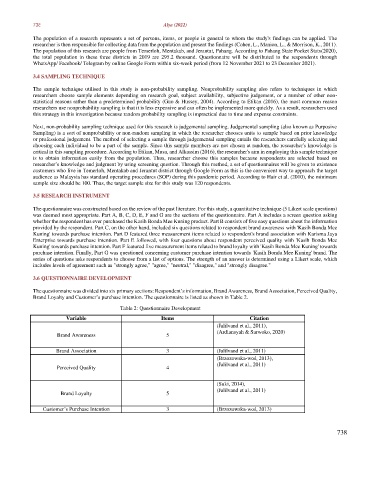
            The questionnaire was divided into six primary sections: Respondent’s information, Brand Awareness, Brand Association, Perceived Quality,
            Brand Loyalty and Customer’s purchase intention. The questionnaire is listed as shown in Table 2.
                                         Table 2: Questionnaire Development

                       Variable                       Items                         Citation
                                                                         (Jalilvand et al., 2011),
                    Brand Awareness                     5                (Ardiansyah & Sarwoko, 2020)


                    Brand Association                   3                (Jalilvand et al., 2011)
                                                                         (Brzozowska-woś, 2013),
                    Perceived Quality                   4                (Jalilvand et al., 2011)


                                                                         (Suki, 2014),
                     Brand Loyalty                      5                (Jalilvand et al., 2011)


               Customer’s Purchase Intention            3                (Brzozowska-woś, 2013)


                                                                                                                 738

