


Page 758 - MARSIUM'21 COMP OF PAPER
P. 758
737                                        Alya (2022)

               market share and attracting loyal customers. Customers that are loyal to a brand are more likely to repurchase and suggest it to others.
               Customers who are loyal to a brand will pay more for it than for similar products (Erics, et al., 2012). Previous research has shown that
               customers who are loyal to a company for a long time make repeat purchases, resulting in profitability and growth (Molla & Licker, 2001
               cited in Mirabi et al., 2015). Previous research indicates that high levels of brand loyalty lead to the purchase of the same brand on an
               ongoing basis (Lee et al. 2009 cited in (Brzozowska-woś, 2013).

               H4: Brand loyalty has a significant effect on customer’ purchase intention

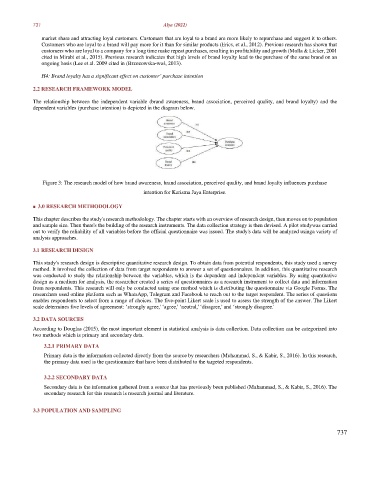
            2.2 RESEARCH FRAMEWORK MODEL

            The  relationship  between  the  independent  variable  (brand  awareness,  brand  association,  perceived  quality,  and  brand  loyalty)  and  the
            dependent variables (purchase intention) is depicted in the diagram below.


               Figure 3: The research model of how brand awareness, brand association, perceived quality, and brand loyalty influences purchase
                                                 intention for Karisma Jaya Enterprise.

            ■  3.0 RESEARCH METHODOLOGY

            This chapter describes the study's research methodology. The chapter starts with an overview of research design, then moves on to population
            and sample size. Then there's the building of the research instruments. The data collection strategy is then devised. A pilot study was carried
            out to verify the reliability of all variables before the official questionnaire was issued. The study's data will be analyzed using a variety of
            analysis approaches.

            3.1 RESEARCH DESIGN

            This study's research design is descriptive quantitative research design. To obtain data from potential respondents, this study used a survey
            method. It involved the collection of data from target respondents to answer a set of questionnaires. In addition, this quantitative research
            was conducted to study the relationship between the variables, which is the dependent and independent variables. By using quantitative
            design as a medium for analysis, the researcher created a series of questionnaires as a research instrument to collect data and information
            from respondents. This research will only be conducted using one method which is distributing the questionnaire via Google Forms. The
            researchers used online platform such as WhatsApp, Telegram and Facebook to reach out to the target respondent. The series of questions
            enables respondents to select from a range of choices. The five-point Likert scale is used to assess the strength of the answer. The Likert
            scale determines five levels of agreement: ‘strongly agree,' ‘agree,' ‘neutral,' ‘disagree,' and ‘strongly disagree.'

            3.2 DATA SOURCES
            According to Douglas (2015), the most important element in statistical analysis is data collection. Data collection can be categorized into
            two methods which is primary and secondary data.

                3.2.1 PRIMARY DATA
                Primary data is the information collected directly from the source by researchers (Muhammad, S., & Kabir, S., 2016). In this research,
                the primary data used is the questionnaire that have been distributed to the targeted respondents.

                3.2.2 SECONDARY DATA
                Secondary data is the information gathered from a source that has previously been published (Muhammad, S., & Kabir, S., 2016). The
                secondary research for this research is research journal and literature.

            3.3 POPULATION AND SAMPLING


                                                                                                                 737

