


Page 761 - MARSIUM'21 COMP OF PAPER
P. 761
740                                        Alya (2022)

            Questionnaires were distributed through online method by google form. A total of 120 questionnaires were answered by respondents from
            12 November 2021 to 23 December 2021. All 120-questionnaire answered by respondent were accepted. The study yielded 100% of response
            rate. A screening question on whether respondents had ever used Kasih Bonda Mee Kuning was asked before they answered the question.
            Further explanation was given to the respondents when they had questions about the questionnaire items.

            4.2 PROFILE OF RESPONDENT

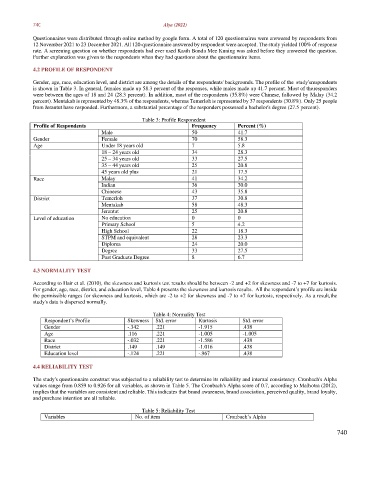
            Gender, age, race, education level, and district are among the details of the respondents' backgrounds. The profile of the  study's respondents
            is shown in Table 3. In general, females made up 58.3 percent of the responses, while males made up 41.7 percent. Most of the responders
            were between the ages of 18 and 24 (28.3 percent). In addition, most of the respondents (35.8%) were Chinese, followed by Malay (34.2
            percent). Mentakab is represented by 48.3% of the respondents, whereas Temerloh is represented by 37 respondents (30.8%). Only 25 people
            from Jerantut have responded. Furthermore, a substantial percentage of the responders possessed a bachelor's degree (27.5 percent).

                                                Table 3: Profile Responedent
            Profile of Respondents                              Frequency       Percent (%)
                                   Male                         50              41.7
            Gender                 Female                       70              58.3
            Age                    Under 18 years old           7               5.8
                                   18 – 24 years old            34              28.3
                                   25 – 34 years old            33              27.5
                                   35 – 44 years old            25              20.8
                                   45 years old plus            21              17.5
            Race                   Malay                        41              34.2
                                   Indian                       36              30.0
                                   Chineese                     43              35.8
            District               Temerloh                     37              30.8
                                   Mentakab                     58              48.3
                                   Jerantut                     25              20.8
            Level of education     No education                 0               0
                                   Primary School               5               4.2
                                   High School                  22              18.3
                                   STPM and equivalent          28              23.3
                                   Diploma                      24              20.0
                                   Degree                       33              27.5
                                   Post Graduate Degree         8               6.7

            4.3 NORMALITY TEST

            According to Hair et al. (2010), the skewness and kurtosis test results should be between -2 and +2 for skewness and -7 to +7 for kurtosis.
            For gender, age, race, district, and education level, Table 4 presents the skewness and kurtosis results.  All the respondent’s profile are inside
            the permissible ranges for skewness and kurtosis, which are -2 to +2 for skewness and -7 to +7 for kurtosis, respectively. As a result, the
            study's data is dispersed normally.

                                                    Table 4: Normality Test
                Respondent’s Profile       Skewness  Std. error    Kurtosis      Std. error
                Gender                     -.342     .221          -1.915        .438
                Age                        .116      .221          -1.005        -1.005
                Race                       -.032     .221          -1.586        .438
                District                   .149      .149          -1.016        .438
                Education level            -.124     .221          -.967         .438

            4.4 RELIABILITY TEST

            The study's questionnaire construct was subjected to a reliability test to determine its reliability and internal consistency. Cronbach's Alpha
            values range from 0.859 to 0.926 for all variables, as shown in Table 5. The Cronbach's Alpha score of 0.7, according to Malhotra (2012),
            implies that the variables are consistent and reliable. This indicates that brand awareness, brand association, perceived quality, brand loyalty,
            and purchase intention are all reliable.

                                                Table 5: Reliability Test
                Variables                     No. of item                   Cronbach’s Alpha

                                                                                                                 740

