


Page 829 - MARSIUM'21 COMP OF PAPER
P. 829
830                                       JieQi & Mazilah (2021)


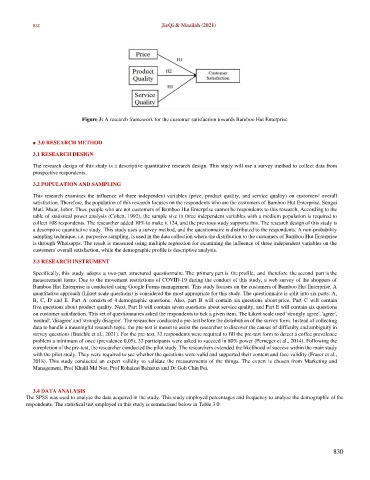
                            Figure 3: A research framework for the customer satisfaction towards Bamboo Hut Enterprise


            ■  3.0 RESEARCH METHOD
            3.1 RESEARCH DESIGN

            The research design of this study is a descriptive quantitative research design. This study will use a survey method to collect data from
            prospective respondents.
            3.2 POPULATION AND SAMPLING

            This  research examines the influence of three independent variables (price, product quality, and service quality) on customers' overall
            satisfaction. Therefore, the population of this research focuses on the respondents who are the customers of Bamboo Hut Enterprise, Sungai
            Mati, Muar, Johor. Thus, people who are not customers of Bamboo Hut Enterprise cannot be respondents to this research. According to the
            table of statistical power analysis (Cohen, 1992), the sample size in three independent variables with a medium population is required to
            collect 108 respondents. The researcher added 10% to make it 124, and the previous study supports this. The research design of this study is
            a descriptive quantitative study. This study uses a survey method, and the questionnaire is distributed to the respondents. A non-probability
            sampling technique, i.e. purposive sampling, is used in the data collection where the distribution to the customers of Bamboo Hut Enterprise
            is through Whatsapps. The result is measured using multiple regression for examining the influence of three independent variables on the
            customers' overall satisfaction, while the demographic profile is descriptive analysis.
            3.3 RESEARCH INSTRUMENT

            Specifically, this  study  adopts  a  two-part  structured  questionnaire. The  primary part is  the profile,  and  therefore  the second  part is the
            measurement items. Due to the movement restrictions of COVID-19 during the conduct of this study, a web survey of the shoppers of
            Bamboo Hut Enterprise is conducted using Google Forms management. This study focuses on the customers of Bamboo Hut Enterprise. A
            quantitative approach (Likert scale questions) is considered the most appropriate for this study. The questionnaire is split into six parts: A,
            B,  C,  D  and  E.  Part  A  consists of  4 demographic  questions.  Also,  part  B  will  contain  six questions  about price.  Part  C  will  contain
            five questions about product quality. Next, Part D will contain seven questions about service quality, and Part E will contain six questions
            on customer satisfaction. This set of questionnaires asked the respondents to tick a given item. The Likert scale used 'strongly agree', 'agree',
            'neutral', 'disagree' and 'strongly disagree'. The researcher conducted a pre-test before the distribution of the survey form. Instead of collecting
            data to handle a meaningful research topic, the pre-test is meant to assist the researcher to discover the causes of difficulty and ambiguity in
            survey questions (Buschle et al., 2021). For the pre-test, 32 respondents were required to fill the pre-test form to detect a coffee prevalence
            problem a minimum of once (prevalence 0.05), 32 participants were asked to succeed in 80% power (Perneger et al., 2014). Following the
            completion of the pre-test, the researcher conducted the pilot study. The researchers extended the likelihood of success within the main study
            with the pilot study. They were required to see whether the questions were valid and supported their content and face validity (Fraser et al.,
            2018). This study conducted an expert  validity to validate the measurements of the things.  The expert  is chosen from  Marketing and
            Management, Prof Khalil Md Nor, Prof Rohaizat Baharun and Dr Goh Chin Fei.


            3.4 DATA ANALYSIS
          The SPSS was used to analyse the data acquired in the study. This study employed percentages and frequency to analyse the demographic of the
          respondents. The statistical test employed in this study is summarised below in Table 3.0:


                                                                                                               830

