


Page 939 - MARSIUM'21 COMP OF PAPER
P. 939
940                                        Teo & Dr Adaviah (2021)

            adds extra value to a company where the business able to improve the efficiency of marketing strategy on Instagram. The brand equitys'
            elements enable a company to gain a competitive edge over its competitors.

                   Brand equity considers a variety of factors, including brand awareness, brand associations, brand loyalty, and perceived quality.
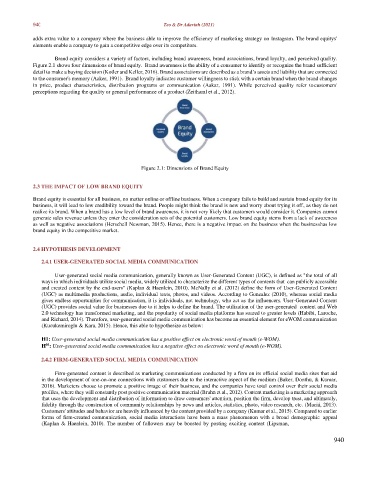
            Figure 2.1 shows four dimensions of brand equity.  Brand awareness is the ability of a consumer to identify or recognize the brand sufficient
            detail to make a buying decision (Kotler and Keller, 2016). Brand associations are described as a brand’s assets and liability that are connected
            to the consumer's memory (Aaker, 1991).  Brand loyalty indicates customer willingness to stick with a certain brand when the brand changes
            in  price,  product  characteristics,  distribution  programs  or  communication  (Aakar,  1991).  While  perceived  quality  refer  to customers'
            perceptions regarding the quality or general performance of a product (Zeithaml et al., 2012).


                                                Figure 2.1: Dimensions of Brand Equity


            2.3 THE IMPACT OF LOW BRAND EQUITY

            Brand equity is essential for all business, no matter online or offline business. When a company fails to build and sustain brand equity for its
            business, it will lead to low credibility toward the brand. People might think the brand is new and worry about trying it off, as they do not
            realize its brand. When a brand has a low level of brand awareness, it is not very likely that customers would consider it. Companies cannot
            generate sales revenue unless they enter the consideration sets of the potential customers. Low brand equity stems from a lack of awareness
            as well as negative associations (Herschell Newman, 2015). Hence, there is a negative impact on the business when the business has low
            brand equity in the competitive market.


            2.4 HYPOTHESIS DEVELOPMENT

               2.4.1 USER-GENERATED SOCIAL MEDIA COMMUNICATION

                   User-generated social media communication, generally known as User-Generated Content (UGC), is defined as "the total of all
               ways in which individuals utilize social media, widely utilized to characterize the different types of contents that  can publicly accessible
               and created content by the end-users" (Kaplan & Haenlein, 2010). McNally et al. (2012) define the form of User-Generated Content
               (UGC) as multimedia productions, audio, individual texts, photos, and videos. According to Gonzalez (2010), whereas social media
               gives endless opportunities for communication, it is individuals, not technology, who act as the influencers. User-Generated Content
               (UGC) provides social value for businesses due to it helps to define the brand. The utilization of the user-generated  content and Web
               2.0 technology has transformed marketing, and the popularity of social media platforms has soared to greater levels (Habibi, Laroche,
               and Richard, 2014). Therefore, user-generated social media communication has become an essential element for eWOM communication
               (Kucukemiroglu & Kara, 2015). Hence, this able to hypothesize as below:

               H1: User-generated social media communication has a positive effect on electronic word of mouth (e-WOM).
                01
               H : User-generated social media communication has a negative effect on electronic word of mouth (e-WOM).

               2.4.2 FIRM-GENERATED SOCIAL MEDIA COMMUNICATION

                   Firm-generated content is described as marketing communications conducted by a firm on its official social media sites that aid
               in the development of one-on-one connections with customers due to the interactive aspect of the medium (Baker, Donthu, & Kumar,
               2016). Marketers choose to promote a positive image of their business, and the companies have total control over their social media
               profiles, where they will constantly post positive communication material (Bruhn et al., 2012). Content marketing is a marketing approach
               that uses the development and distribution of information to draw consumers' attention, position the firm, develop trust, and ultimately,
               fidelity through the construction of community relationships by news and articles, statistics, photo, video research, etc. (Maciá, 2013).
               Customers' attitudes and behavior are heavily influenced by the content provided by a company (Kumar et al., 2015). Compared to earlier
               forms of firm-created communication, social media interactions have been a mass phenomenon with a broad demographic  appeal
               (Kaplan & Haenlein, 2010). The number of followers  may be boosted by posting exciting content (Lipsman,

                                                                                                                940

