


Page 940 - MARSIUM'21 COMP OF PAPER
P. 940
941                                        Teo & Dr Adaviah (2021)

               Mudd, Rich, & Bruich, 2012). Therefore, it's critical to figure out which types of content get the most attention and which messages get
               the best results to figure out what items to advertise and what kind of promotions are much more attractive, the idea is that the content
               creates a relationship with the business (Santana et al., 2012). According to Tsimonis and Dimiatris (2014), constructive firm- generated
               content on social media helps businesses to develop positive eWOM. The following hypothesis is presented as a result of the above
               reasons:

               H2: Firm-generated social media communication has a positive effect on electronic word of mouth (e-WOM).
               H : Firm-generated social media communication has a negative effect on electronic word of mouth (e-WOM).
                02

               2.4.3 ELECTRONIC WORD OF MOUTH (E-WOM)

                  Traditional word of mouth was revolutionized by the development of the Internet and the expansion of social media,  which brought
               it to electronic level and converted it into electronic word of mouth  (e-WOM) (Mishra & S M, 2016). The term electronic word of mouth
               (e-WOM) refers to the process of conveying and collecting information, as well as service and product recommendations, through various
               media channels (Abrantes et al.,2013), when the communicator and recipient are separated in location and time (Steffes & Burgee, 2009).
               Today,  eWOM  is  the  most  prevalent  method  of  gathering  brand  information  that  may  be  utilized  to  influence  customer  product
               assessments (Kudeshia & Kumar, 2017). People throughout the world actively express their views, making an effect on problems that
               interest them (Kucukemiroglu & Kara, 2015). Customers create content regarding brands, products, services, and experiences, which
               they could share with other consumers (Kim et al., 2015). Online reviews aid people in their purchasing decision process while also
               increasing the company's revenue (Kudeshia & Kumar, 2017). According to Lin & Xu (2017), these reviews influenced almost 50% of
               buying decisions made in stores. Therefore, this can be hypothesized the e-WOM has a direct association with brand equity.

               H3: Electronic word of mouth (e-WOM) has a positive and direct impact on brand equity.
                03
               H : Electronic word of mouth (e-WOM) has a negative and direct impact on brand equity.

               2.4.4 REPURCHASE INTENTION

                   Repurchase intention has been identified as the possibility of buying the brand items again (Chen et al., 2016). Repurchase intention
               is defined by Fang et al. (2017) as customers' predisposition to buy items from the same producer over a lengthy period of time. According
               to Wu et al. (2014), repurchase also known as retention, which is frequently regarded one of the most essential elements in marketing
               concept. Businesses should be concerned about their customers' repurchase intentions, especially if they want to expand service and
               product sales. Its in accordance with Lin & Lekhawipat (2014) who stated that repurchase intention could encompass not just desire to
               buy the product again, but also desire to promote it to family and friends. Customer repurchase intention is strongly influenced by brand
               awareness, which is essential and vital constraint in brand-related investigations (Kapferer, 2008). Pather,
               P. (2017) indicated that  repurchase intention had been influenced by brand association. According to Chaudhuri  (2002), customer
               repurchase intention would be high when customers’ perceived quality increase. Loyalty is an important factor in achieving lengthy
               profitability, customer repurchase intention, and competitiveness (Nguyen and Liem, 2013). Thus, the following hypothesis  is presented
               as a result of the above reasons:

               H4: Brand equity has a positive and direct impact on repurchase intention.
                04
               H : Brand equity has a negative and direct impact on repurchase intention.


            2.5 RESEARCH FRAMEWORK MODEL


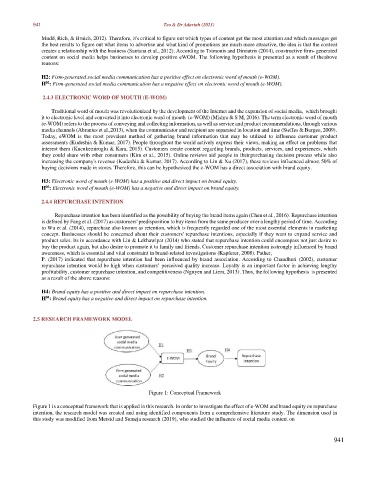
                                                  Figure 1: Conceptual Framework

            Figure 1 is a conceptual framework that is applied in this research. In order to investigate the effect of e-WOM and brand equity on repurchase
            intention, the research model was created and using identified components from a comprehensive literature study. The dimension used in
            this study was modified from Mersid and Sumeja research (2019), who studied the influence of social media content on


                                                                                                                941

