


Page 943 - MARSIUM'21 COMP OF PAPER
P. 943
944                                        Teo & Dr Adaviah (2021)

                3.7 DATA ANALYSIS

                   Data analysis is a set  of techniques for detecting patterns,  identifying facts,  developing explanations, and testing hypotheses
            (Malhotra, 2009). Quantitative research seeks insight through a less organized and more flexible method, whereas qualitative research
            generates insights that are not reached by statistical techniques or other quantification methods (Hoepfl, 2015). The data for this study is
            processed and analyzed using the Statistical Package for Social Sciences (SPSS) software for descriptive analysis, normality testing and
            demographic data analysis. In contrast, Smart Partial Least Squares software will be used to test hypotheses and evaluate the connection
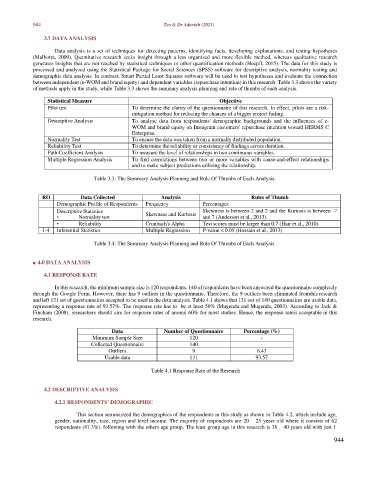
            between independent (e-WOM and brand equity) and dependent variables (repurchase intention) in this research. Table 3.3 shows the variety
            of methods apply in the study, while Table 3.3 shows the summary analysis planning and rule of thumbs of each analysis.

                 Statistical Measure                                      Objective
                 Pilot test                  To determine the clarity of the questionnaire of this research. In effect, pilots are a risk-
                                             mitigation method for reducing the chances of a bigger project failing.
                 Descriptive Analysis        To  analyse  data  from  respondents'  demographic  backgrounds  and  the  influences  of  e-
                                             WOM and brand equity on Instagram customers' repurchase intention toward HERMS C
                                             Enterprise.
                 Normality Test              To ensure the data was taken from a normally distributed population.
                 Reliability Test            To determine the reliability or consistency of findings across duration.
                 Path Coefficient Analysis   To measure the level of relationships in two continuous variables.
                 Multiple Regression Analysis   To  find correlations between two  or more variables  with  cause-and-effect  relationships
                                             and to make subject predictions utilizing the relationship.

                                Table 3.3: The Summary Analysis Planning and Rule Of Thumbs of Each Analysis.


               RO           Data Collected            Analysis                      Rules of Thumb
                    Demographic Profile of Respondents   Frequency   Percentages
                    Descriptive Statistics       Skewness and Kurtosis   Skewness is between-2 and 2 and the Kurtosis is between -7
                    •      Normality test                           and 7 (Anderson et al., 2013).
                    •      Reliability           Cronbach's Alpha   Test scores must be larger than 0.7 (Hair et al., 2010).
               1-4   Inferential Statistics      Multiple Regression   P-value < 0.05 (Hossain et al., 2013)

                                Table 3.4: The Summary Analysis Planning and Rule Of Thumbs of Each Analysis.


            ■  4.0 DATA ANALYSIS

                4.1 RESPONSE RATE

                   In this research, the minimum sample size is 120 respondents. 140 of respondents have been answered the questionnaire completely
            through the Google Form. However, there has 9 outliers in the questionnaire. Therefore, the 9 outliers been eliminated from this research
            and left 131 set of questionnaires accepted to be used in the data analysis. Table 4.1 shows that 131 out of 140 questionnaires are usable data,
            representing a response rate of 93.57%. The response rate has to  be at least 50% (Mugenda and Mugenda, 2003). According to Jack &
            Fincham (2008), researchers should aim for response rates of around 60% for most studies. Hence, the response rate is acceptable in this
            research.

                                      Data             Number of Questionnaire    Percentage (%)
                                Minimum Sample Size             120                    -
                               Collected Questionnaire          140                    -
                                     Outliers                    9                    6.43
                                    Usable data                 131                   93.57

                                                   Table 4.1 Response Rate of the Research


                4.2 DESCRIPTIVE ANALYSIS

                   4.2.1 RESPONDENTS’ DEMOGRAPHIC

                          This section summarized the demographics of the respondents in this study as shown in Table 4.2, which include age,
                   gender, nationality, race, region and level income. The majority of respondents are 20  – 25 years old where it consists of 62
                   respondents (47.3%), following with the others age group. The least group age in this research is 36 – 40 years old with just 1

                                                                                                                944

