


Page 942 - MARSIUM'21 COMP OF PAPER
P. 942
943                                        Teo & Dr Adaviah (2021)

                 3.5 DATA COLLECTION METHOD

                   Regardless of the topic of study, data collecting is at the core of this research. Any research project begins with a set of questions
            that must be addressed (Dr. Huma Parveen & Nayeem Showkat, 2017). This study's data collection method is questionnaires distributed to
            Instagram followers of HERMS C Enterprise. Rupesh (2010) claims that questionnaires are highly cost effective compared  with interviews.
            Therefore, the researcher would request the founder of HERMS C Enterprise to post a set of online questionnaire in the Google Form on its
            Instagram page for its customers who are familiar and unfamiliar with its brand.

                   3.5.1 PRIMARY DATA

                          Questionnaires were used to collect primary data, which were organized based on the research questions listed in chapter
                   one. There have four sections in the questionnaires. There are both open and closed-ended questions in  the questionnaires, which
                   provide the advantage of being easier for respondents to evaluate. According to Michael R Hyman & Jeremy J. Sierra (2016), it is
                   easier to respond to closed-ended questions regarding attitudes and behaviours. The questionnaire would involve a 5-point Likert
                   scale of 1-5. The purpose of collecting primary data is to study the effect of e-WOM and brand equity to repurchase intention
                   toward HERMS C Enterprise. However, primary data would not be sufficient to support this research. Therefore, secondary data
                   is needed in this research as well.

                   3.5.1 SECONDARY DATA

                          Secondary data is information that has been gathered and collated by someone and is available to the general public (Dr.
                   Huma Parveen & Nayeem Showkat, 2017). The secondary data of this research is from the Internet, which are Science Direct,
                   Google Sholar, academic articles, e-book and articles. Moreover, there have a variety of statistical results conducted by the previous
                   researchers would also be collected as secondary data to support this research. Hence, secondary data is essential to help the
                   researcher develops research questions, formulate the research designs, answer research questions, and provide insight into the
                   study.


                3.6 RESEARCH MEASURE AND INSTRUMENT

                   Primary data would be collected via online questionnaires, which provide the researcher with first-hand data and trustworthy
            information for this research. A structured questionnaire was utilized in the study as the data collection method. The questionnaire was
            divided into four sections: personal information (age, gender, nationality, race and income levels), the brand equity of HERMS C Enterprise,
            e-WOM (user-generated and firm-generated social media communication) and lastly is repurchase intention toward HERMS C Enterprise.
            The questionnaire represents a set of questions designed to gather information from specific respondents (Malhotra, 2009).

                   Furthermore, the questionnaires would be designed as multiple-choice questions and open-ended questions. All components in this
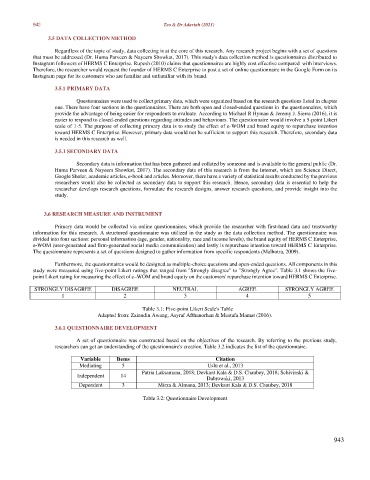
            study were measured using five-point Likert ratings that ranged from "Strongly disagree" to "Strongly Agree". Table 3.1 shows the five-
            point Likert rating for measuring the effect of e–WOM and brand equity on the customers' repurchase intention toward HERMS C Enterprise.

            STRONGLY DISAGREE         DISAGREE            NEUTRAL               AGREE          STRONGLY AGREE
                     1                    2                   3                   4                    5

                                                Table 3.1: Five-point Likert Scale's Table
                                 Adapted from: Zainudin Awang, Asyraf Afthanorhan & Mustafa Mamat (2016).

                   3.6.1 QUESTIONNAIRE DEVELOPMENT

                          A set of questionnaire was constructed based on the objectives of the research. By referring to the previous study,
                   researchers can get an understanding of the questionnaire's creation. Table 3.2 indicates the list of the questionnaire.

                            Variable    Items                           Citation
                           Mediating     5                            Uslu et al., 2013
                                                Patria Laksamana, 2018; Devkant Kala & D.S. Chaubey, 2018; Schivinski &
                           Independent   14                          Dabrowski, 2013
                           Dependent     3           Mirza & Almana, 2013; Devkant Kala & D.S. Chaubey, 2018

                                                Table 3.2: Questionnaire Development


                                                                                                                943

