


Page 957 - MARSIUM'21 COMP OF PAPER
P. 957
958                                        Woon & Grace (2022)

            products corroborates this finding (Lee & Yu, 2018). Researchers found that  perceived quality is positively associated with  consumer
            decisions. Consequently, the following hypotheses are proposed:

            H3a. The perceived quality has a positive and significant influence on the brand attitude of robotics education.
            H3b. The perceived quality has a positive and significant influence on the purchase intention of robotics education.


            2.2.4 Brand Attitude and Purchase Intention

               Purchase intention is defined as the likelihood that consumers will purchase a particular product or service in the future (Youssef and
            Hind, 2020). Purchase intention also refers to an individual’s possibility of buying a product/brand and is closely related to consumer
            perceptions and attitudes (Sheeraz et al., 2016). Consumers can change their decisions influenced by price, quality, and perceived value.

               Previous studies have investigated the relationship between brand attitude and purchase intention in the dimensions of advertising, brand,
            and advertiser (Sheeraz et al., 2016). Customer attitude towards a brand is a predisposition that focuses on favourable or unfavourable effects
            towards a particular brand after seeing an advertisement. When customers have a more positive attitude towards the brand, they are more
            likely to engage (Costanza et al., 2021). Therefore, brand attitude strategy is an interaction between a potential consumer’s engagement in
            the purchase decision and the underlying motivation.

               Consumer brand attitude can affect purchase intention (Sheeraz et al., 2016). Several studies show that brand equity increases purchase
            intention (Jung and Seock, 2016; Liu et al., 2017; Srisawat and Singnapatpokin, 2019). Moreover, Youseff and Hind (2020) highlighted that
            consumers are more likely to connect with companies related to their interests. The degree of familiarity generates positive emotions towards
            brand attitude and increases purchase intention. As such, the following hypothesis is postulated:

            H4: The brand attitude has a positive and significant influence on the purchase intention of robotics education.


             2.3 RESEARCH FRAMEWORK


                                                  H1a         BRAND ATTITUDE

                           BRAND AWARENESS                                            H4
                                                               H1b
                                               H2a
                                                                                       PURCHASE
                                                               H2b
                                 BRAND                                                 INTENTION
                             ASSOCIATIONS

                                                   H3a
                                                               H3b
                               PERCEIVED
                                QUALITY


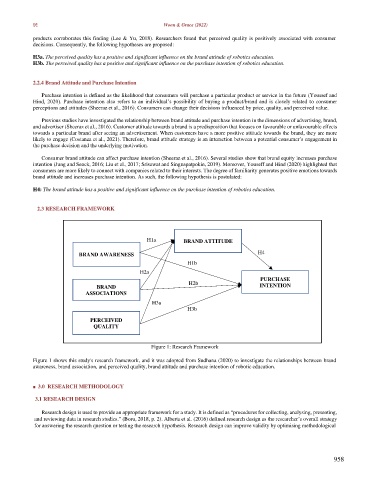
                                                   Figure 1: Research Framework

            Figure 1 shows this study's research framework, and it was adopted from Sudhana (2020) to investigate the relationships between brand
            awareness, brand association, and perceived quality, brand attitude and purchase intention of robotic education.


            ■  3.0  RESEARCH METHODOLOGY

             3.1 RESEARCH DESIGN

               Research design is used to provide an appropriate framework for a study. It is defined as “procedures for collecting, analysing, presenting,
            and reviewing data in research studies.” (Boru, 2018, p. 2). Alberta et al. (2016) defined research design as the researcher’s overall strategy
            for answering the research question or testing the research hypothesis. Research design can improve validity by optimising methodological


                                                                                                                958

