


Page 960 - MARSIUM'21 COMP OF PAPER
P. 960
961                                        Woon & Grace (2022)


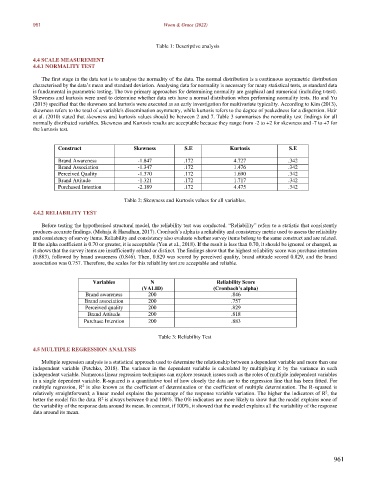
                                                     Table 1: Descriptive analysis

            4.4 SCALE MEASUREMENT
            4.4.1 NORMALITY TEST

               The first stage in the data test is to analyse the normality of the data. The normal distribution is a continuous asymmetric distribution
            characterised by the data’s mean and standard deviation. Analysing data for normality is necessary for many statistical tests, as standard data
            is fundamental in parametric testing. The two primary approaches for determining normality are graphical and numerical (including t-test).
            Skewness and kurtosis were used to determine whether data sets have a normal distribution when performing normality tests. Ho and Yu
            (2015) specified that the skewness and kurtosis were executed as an early investigation for multivariate typicality. According to Kim (2013),
            skewness refers to the total of a variable's dissemination asymmetry, while kurtosis refers to the degree of peakedness for a dispersion. Hair
            et al. (2010) stated that skewness and kurtosis values should be between 2 and 7. Table 3 summarises the normality test findings for all
            normally distributed variables. Skewness and Kurtosis results are acceptable because they range from -2 to +2 for skewness and -7 to +7 for
            the kurtosis test.


                    Construct                Skewness         S.E            Kurtosis            S.E
                    Brand Awareness            -1.847         .172            4.727             .342
                    Brand Association          -1.347         .172            1.476             .342
                    Perceived Quality          -1.370         .172            1.690             .342
                    Brand Attitude             -1.321         .172            1.717             .342
                    Purchased Intention        -2.189         .172            4.475             .342

                                          Table 2: Skewness and Kurtosis values for all variables.

            4.4.2 RELIABILITY TEST

               Before testing the hypothesised structural model, the reliability test was conducted. “Reliability” refers to a statistic that consistently
            produces accurate findings. (Mohaja & Haradhan, 2017). Cronbach’s alpha is a reliability and consistency metric used to assess the reliability
            and consistency of survey items. Reliability and consistency also evaluate whether survey items belong to the same construct and are related.
            If the alpha coefficient is 0.70 or greater, it is acceptable (Yen et al., 2018). If the result is less than 0.70, it should be ignored or changed, as
            it shows that the survey items are insufficiently related or distinct. The findings show that the highest reliability score was purchase intention
            (0.883), followed by brand awareness (0.846). Then, 0.829 was scored by perceived quality, brand attitude scored 0.829, and the brand
            association was 0.757. Therefore, the scales for this reliability test are acceptable and reliable.


                                Variables          N                     Reliability Score
                                                (VALID)                 (Cronbach’s alpha)
                             Brand awareness      200                         .846
                             Brand association    200                         .757
                             Perceived quality    200                         .829
                              Brand Attitude      200                         .818
                             Purchase Intention   200                         .883

                                                     Table 3: Reliability Test

            4.5 MULTIPLE REGRESSION ANALYSIS

               Multiple regression analysis is a statistical approach used to determine the relationship between a dependent variable and more than one
            independent  variable  (Petchko,  2018).  The  variance  in  the  dependent  variable  is  calculated  by  multiplying  it  by  the  variance  in  each
            independent variable. Numerous linear regression techniques can explore research issues such as the roles of multiple independent variables
            in a single dependent variable. R-squared is a quantitative tool of how closely the data are to the regression line that has been fitted. For
            multiple regression, R  is also known as the coefficient of determination or the coefficient of multiple determination. The R-squared is
                            2
                                                                                                             2
            relatively straightforward; a linear model explains the percentage of the response variable variation. The higher the indicators of R , the
            better the model fits the data. R  is always between 0 and 100%. The 0% indicators are more likely to show that the model explains none of
                                   2
            the variability of the response data around its mean. In contrast, if 100%, it showed that the model explains all the variability of the response
            data around its mean.


                                                                                                                961

