


Page 80 - Health, Population and Environment Education 9
P. 80
Population distribution by development regions
          All the development regions in Nepal have no equal availability of facilities and services.
          Hence, there is no equal distribution of population in all the development regions. Central
          development region has the highest population distribution and far western development
          has the least population distribution.

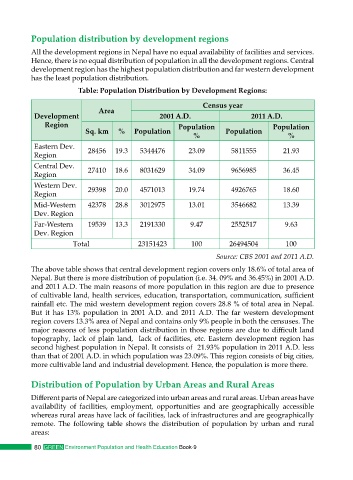
                        Table: Population Distribution by Development Regions:
                                                            Census year
                              Area
           Development                         2001 A.D.                  2011 A.D.
              Region                                 Population                 Population
                          Sq. km   %    Population                 Population
                                                         %                           %
           Eastern Dev.    28456   19.3   5344476       23.09       5811555        21.93
           Region
           Central Dev.
           Region          27410   18.6   8031629       34.09       9656985        36.45
           Western Dev.    29398   20.0   4571013       19.74       4926765        18.60
           Region
           Mid-Western     42378   28.8   3012975       13.01       3546682        13.39
           Dev. Region
           Far-Western     19539   13.3   2191330       9.47        2552517         9.63
           Dev. Region
                      Total              23151423        100        26494504        100

                                                                Source: CBS 2001 and 2011 A.D.
          The above table shows that central development region covers only 18.6% of total area of
          Nepal. But there is more distribution of population (i.e. 34. 09% and 36.45%) in 2001 A.D.
          and 2011 A.D. The main reasons of more population in this region are due to presence
          of cultivable land, health services, education, transportation, communication, sufficient
          rainfall etc. The mid western development region covers 28.8 % of total area in Nepal.
          But it has  13%  population in  2001 A.D.  and  2011 A.D. The  far western development
          region covers 13.3% area of Nepal and contains only 9% people in both the censuses. The
          major reasons of less population distribution in those regions are due to difficult land
          topography, lack of plain land,  lack of facilities, etc. Eastern development region has
          second highest population in Nepal. It consists of  21.93% population in 2011 A.D. less
          than that of 2001 A.D. in which population was 23.09%. This region consists of big cities,
          more cultivable land and industrial development. Hence, the population is more there.


          Distribution of Population by Urban Areas and Rural Areas
          Different parts of Nepal are categorized into urban areas and rural areas. Urban areas have
          availability  of facilities, employment, opportunities and are geographically  accessible
          whereas rural areas have lack of facilities, lack of infrastructures and are geographically
          remote. The following table shows the distribution of population by urban and rural
          areas:
           80  GREEN Environment Population and Health Education Book-9

