


Page 83 - Health, Population and Environment Education 9
P. 83
Provision of necessary infrastructures for international playgrounds.
                Sufficient  opportunities  for  higher  education  and  presence  of  at  least  one  local
                university.
                Adequate urban facilities and should have acquired the level of sub metropolitan city.


            Trend of Urbanization in Nepal
            The historical studies show the  existence of ancient  towns in Kathmandu, Bhadgaun,
            Patan,  Panauti, Lumbini, Jankpur, Biratnagar, etc. However, the remainings and proofs of
            such towns are less present. Nowadays, urbanization is explained in modern perspective.
            Urbanization  has  been  explained  in  Nepal    since  1952/54  A.D.  (2009/11  B.S.)  census
            onwards. At that time, any place having 5000 or more population was regarded as urban
            area. There was 2.9% people living in urban area in  Nepal at that time. But, with the
            passing of time, there has been extension of urban areas and increase of population in
            urban areas. People in rural areas are attracted towards several facilities in urban areas.
            Hence, there is increase of migration of people from rural areas to urban areas. The trend
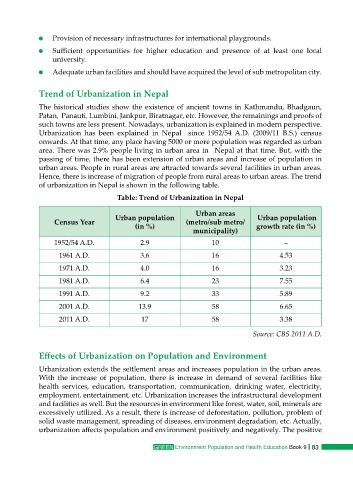
            of urbanization in Nepal is shown in the following table.
                                   Table: Trend of Urbanization in Nepal

                                                          Urban areas
                                   Urban population                         Urban population
                 Census Year                           (metro/sub metro/
                                        (in %)                             growth rate (in %)
                                                         municipality)
                 1952/54 A.D.             2.9                  10                   –
                  1961 A.D.               3.6                  16                 4.53

                  1971 A.D.               4.0                  16                 3.23
                  1981 A.D.               6.4                  23                 7.55
                  1991 A.D.               9.2                  33                 5.89

                  2001 A.D.              13.9                  58                 6.65
                  2011 A.D.               17                   58                 3.38

                                                                          Source: CBS 2011 A.D.

            Effects of Urbanization on Population and Environment

            Urbanization extends the settlement areas and increases population in the urban areas.
            With the increase  of  population, there is  increase  in  demand  of  several  facilities  like
            health  services, education, transportation,  communication, drinking  water,  electricity,
            employment, entertainment, etc. Urbanization increases the infrastructural development
            and facilities as well. But the resources in environment like forest, water, soil, minerals are
            excessively utilized. As a result, there is increase of deforestation, pollution, problem of
            solid waste management, spreading of diseases, environment degradation, etc. Actually,
            urbanization affects population and environment positively and negatively. The positive

                                              GREEN  Environment Population and Health Education Book-9 83

