


Page 81 - Health, Population and Environment Education 9
P. 81
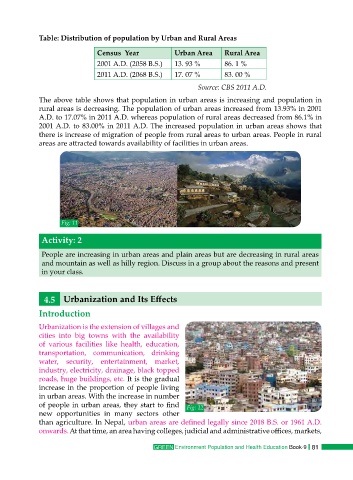
Table: Distribution of population by Urban and Rural Areas

                             Census  Year           Urban Area    Rural Area
                             2001 A.D. (2058 B.S.)  13. 93 %      86. 1 %
                             2011 A.D. (2068 B.S.)  17. 07 %      83. 00 %
                                                           Source: CBS 2011 A.D.
            The above table shows that population in urban areas is increasing and population in
            rural areas is decreasing. The population of urban areas increased from 13.93% in 2001
            A.D. to 17.07% in 2011 A.D. whereas population of rural areas decreased from 86.1% in
            2001 A.D. to 83.00% in 2011 A.D. The increased population in urban areas shows that
            there is increase of migration of people from rural areas to urban areas. People in rural
            areas are attracted towards availability of facilities in urban areas.


                   Fig: 11
             Activity: 2

             People are increasing in urban areas and plain areas but are decreasing in rural areas
             and mountain as well as hilly region. Discuss in a group about the reasons and present
             in your class.


              4.5  Urbanization and Its Effects

            Introduction
            Urbanization is the extension of villages and
            cities into big towns with the availability
            of  various  facilities like health, education,
            transportation,  communication, drinking
            water, security, entertainment, market,
            industry, electricity, drainage, black topped
            roads, huge buildings, etc. It is the gradual
            increase in the proportion of people living
            in urban areas. With the increase in number
            of people in urban areas, they start to find   Fig: 12
            new opportunities  in many sectors other
            than agriculture. In Nepal, urban areas are defined legally since 2018 B.S. or 1961 A.D.
            onwards. At that time, an area having colleges, judicial and administrative offices, markets,

                                              GREEN  Environment Population and Health Education Book-9 81

