


Page 346 - leadership-experience-2008
P. 346
CikguOnline
         CikguOnline
               Leader’s Self-Insight 11.1                                        Getty Images


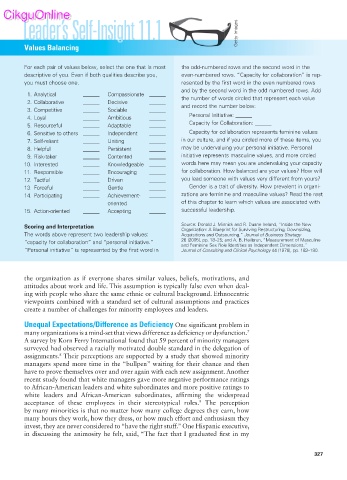
               For each pair of values below, select the one that is most   the odd-numbered rows and the second word in the
               descriptive of you. Even if both qualities describe you,   even-numbered rows. “Capacity for collaboration” is rep-
               you must choose one.                             resented by the first word in the even numbered rows
                                                                and by the second word in the odd numbered rows. Add
                 1. Analytical   ______   Compassionate ______
                                                                the number of words circled that represent each value
                 2. Collaborative   ______   Decisive   ______
                                                                and record the number below:
                 3. Competitive   ______   Sociable   ______
                                                                  Personal Initiative: ______
                 4. Loyal        ______   Ambitious   ______
                                                                  Capacity for Collaboration: ______
                 5. Resourceful   ______   Adaptable  ______
                 6. Sensitive to others  ______   Independent   ______  Capacity for collaboration represents feminine values
                 7. Self-reliant   ______  Uniting    ______    in our culture, and if you circled more of these items, you
                 8. Helpful      ______  Persistent   ______    may be undervaluing your personal initiative. Personal
                 9. Risk-taker   ______  Contented    ______    initiative represents masculine values, and more circled
               10. Interested    ______  Knowledgeable ______   words here may mean you are undervaluing your capacity
               11. Responsible   ______  Encouraging  ______    for collaboration. How balanced are your values? How will
               12. Tactful       ______   Driven      ______    you lead someone with values very different from yours?
               13. Forceful      ______   Gentle      ______      Gender is a trait of diversity. How prevalent in organi-
               14. Participating   ______   Achievement-  ______  zations are feminine and masculine values? Read the rest
                                         oriented               of this chapter to learn which values are associated with
               15. Action-oriented   ______   Accepting  ______  successful leadership.

                                                                Source: Donald J. Minnick and R. Duane Ireland, “Inside the New
               Scoring and Interpretation
                                                                Organization: A Blueprint for Surviving Restructuring, Downsizing,
               The words above represent two leadership values:   Acquisitions and Outsourcing.” Journal of Business Strategy
                                                                26 (2005), pp. 18–25; and A. B. Heilbrun, “Measurement of Masculine
               “capacity for collaboration” and “personal initiative.”
                                                                and Feminine Sex Role Identities as Independent Dimensions.”
               “Personal initiative” is represented by the first word in   Journal of Consulting and Clinical Psychology 44 (1976), pp. 183–190.

               the organization as if everyone shares similar values, beliefs, motivations, and
               attitudes about work and life. This assumption is typically false even when deal-
               ing with people who share the same ethnic or cultural background. Ethnocentric
               viewpoints combined with a standard set of cultural assumptions and practices
               create a number of challenges for minority employees and leaders.


               Unequal Expectations/Difference as Deficiency One significant problem in
               many organizations is a mind-set that views difference as defi ciency or dysfunction. 7
               A survey by Korn Ferry International found that 59 percent of minority managers
               surveyed had observed a racially motivated double standard in the delegation of
                          8
               assignments.  Their perceptions are supported by a study that showed minority
               managers spend more time in the “bullpen” waiting for their chance and then
               have to prove themselves over and over again with each new assignment. Another
               recent study found that white managers gave more negative performance ratings
               to African-American leaders and white subordinates and more positive ratings to

               white leaders and  African-American subordinates, affirming the widespread
                                                                     9
               acceptance of these employees in their stereotypical roles.  The  perception
               by many minorities is that no matter how many college degrees they earn, how
               many hours they work, how they dress, or how much effort and enthusiasm they
               invest, they are never considered to “have the right stuff.” One Hispanic executive,

               in discussing the animosity he felt, said, “The fact that I graduated first in my

                                                                                                         327

