


Page 124 - Essentials of Nursing Leadership and Management, 5th Edition
P. 124
CikguOnline
         2208_Ch08_103-114.qxd  11/6/09  5:58 PM  Page 111
                                                                    chapter 8 | People and the Process of Change 111       CikguOnline
                 table 8-2
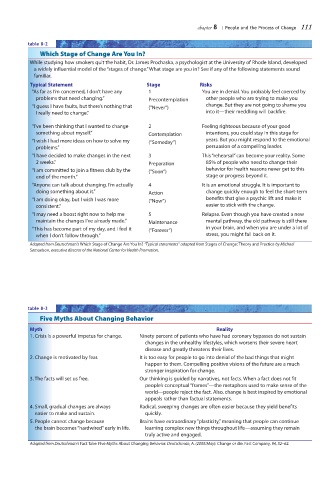
                    Which Stage of Change Are You In?
                 While studying how smokers quit the habit, Dr. James Prochaska, a psychologist at the University of Rhode Island, developed
                  a widely influential model of the “stages of change.”What stage are you in? See if any of the following statements sound
                  familiar.
                 Typical Statement                  Stage           Risks
                  “As far as I’m concerned, I don’t have any   1     You are in denial. You probably feel coerced by
                   problems that need changing.”     Precontemplation  other people who are trying to make you
                  “I guess I have faults, but there’s nothing that   (“Never”)  change. But they are not going to shame you
                   I really need to change.”                          into it—their meddling will backfire.

                  “I’ve been thinking that I wanted to change  2     Feeling righteous because of your good
                   something about myself.”          Contemplation    intentions, you could stay in this stage for
                  “I wish I had more ideas on how to solve my  (“Someday”)  years. But you might respond to the emotional
                   problems.”                                         persuasion of a compelling leader.
                  “I have decided to make changes in the next   3    This “rehearsal”can become your reality. Some
                   2 weeks.”                         Preparation      85% of people who need to change their
                  “I am committed to join a fitness club by the  (“Soon”)  behavior for health reasons never get to this
                   end of the month.”                                 stage or progress beyond it.
                  “Anyone can talk about changing. I’m actually  4   It is an emotional struggle. It is important to
                   doing something about it.”        Action           change quickly enough to feel the short-term
                  “I am doing okay, but I wish I was more   (“Now”)   benefits that give a psychic lift and make it
                   consistent.”                                       easier to stick with the change.
                  “I may need a boost right now to help me   5       Relapse. Even though you have created a new
                   maintain the changes I’ve already made.”  Maintenance  mental pathway, the old pathway is still there
                  “This has become part of my day, and I feel it  (“Forever”)  in your brain, and when you are under a lot of
                   when I don’t follow through.”                      stress, you might fall back on it.
                 Adapted from Deutschman’s Which Stage of Change Are You In? “Typical statements” adapted from Stages of Change: Theory and Practice by Michael
                 Samuelson, executive director of the National Center for Health Promotion.


                 table 8-3
                    Five Myths About Changing Behavior
                 Myth                                                    Reality
                 1. Crisis is a powerful impetus for change.  Ninety percent of patients who have had coronary bypasses do not sustain
                                                    changes in the unhealthy lifestyles, which worsens their severe heart
                                                    disease and greatly threatens their lives.
                 2. Change is motivated by fear.  It is too easy for people to go into denial of the bad things that might
                                                    happen to them. Compelling positive visions of the future are a much
                                                    stronger inspiration for change.
                 3. The facts will set us free.   Our thinking is guided by narratives, not facts. When a fact does not fit
                                                    people’s conceptual “frames”—the metaphors used to make sense of the
                                                    world—people reject the fact. Also, change is best inspired by emotional
                                                    appeals rather than factual statements.
                 4. Small, gradual changes are always   Radical, sweeping changes are often easier because they yield benefits
                   easier to make and sustain.      quickly.
                 5. People cannot change because   Brains have extraordinary “plasticity,”meaning that people can continue
                   the brain becomes “hardwired”early in life.  learning complex new things throughout life—assuming they remain
                                                    truly active and engaged.
                 Adapted from Deutschman’s Fact Take: Five Myths About Changing Behavior. Deutschman, A. (2005/May). Change or die. Fast Company, 94, 52–62.

