


Page 120 - Essentials of Nursing Leadership and Management, 5th Edition
P. 120
CikguOnline
         2208_Ch08_103-114.qxd  11/6/09  5:58 PM  Page 107
                                                                    chapter 8 | People and the Process of Change 107       CikguOnline
                 be a very small change in routine had provoked sur-  written materials distributed to everyone involved
                 prisingly strong resistance because it threatened the  via print or electronic means.
                 clerk’s sense of importance and power.
                                                             Disconfirming Currently Held Beliefs
                 Recognizing Resistance                      Disconfirming current beliefs is a primary force for
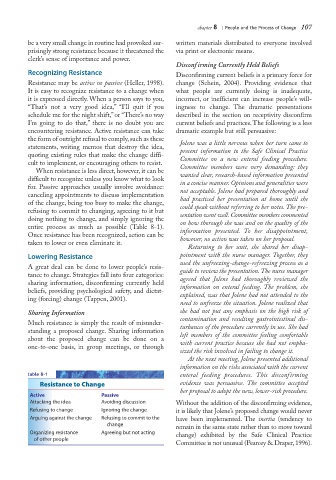
                 Resistance may be active or passive (Heller, 1998).  change (Schein, 2004). Providing evidence that
                 It is easy to recognize resistance to a change when  what people are currently doing is inadequate,
                 it is expressed directly. When a person says to you,  incorrect, or inefficient can increase people’s will-
                 “That’s not a very good idea,” “I’ll quit if you  ingness to change. The dramatic presentations
                 schedule me for the night shift,”or “There’s no way  described in the section on receptivity disconfirm
                 I’m going to do that,” there is no doubt you are  current beliefs and practices.The following is a less
                 encountering resistance. Active resistance can take  dramatic example but still persuasive:
                 the form of outright refusal to comply,such as these
                                                              Jolene was a little nervous when her turn came to
                 statements, writing memos that destroy the idea,
                                                              present information to the Safe Clinical Practice
                 quoting existing rules that make the change diffi-
                                                              Committee on a new enteral feeding procedure.
                 cult to implement, or encouraging others to resist.
                                                              Committee members were very demanding: they
                   When resistance is less direct, however, it can be
                                                              wanted clear, research-based information presented
                 difficult to recognize unless you know what to look
                                                              in a concise manner. Opinions and generalities were
                 for. Passive approaches usually involve avoidance:
                                                              not acceptable. Jolene had prepared thoroughly and
                 canceling appointments to discuss implementation
                                                              had practiced her presentation at home until she
                 of the change, being too busy to make the change,
                                                              could speak without referring to her notes. The pre-
                 refusing to commit to changing, agreeing to it but
                                                              sentation went well. Committee members commented
                 doing nothing to change, and simply ignoring the
                                                              on how thorough she was and on the quality of the
                 entire process as much as possible (Table 8-1).
                                                              information presented. To her disappointment,
                 Once resistance has been recognized, action can be
                                                              however, no action was taken on her proposal.
                 taken to lower or even eliminate it.
                                                                 Returning to her unit, she shared her disap-
                 Lowering Resistance                          pointment with the nurse manager. Together, they
                                                              used the unfreezing-change-refreezing process as a
                 A great deal can be done to lower people’s resis-
                                                              guide to review the presentation.The nurse manager
                 tance to change. Strategies fall into four categories:
                                                              agreed that Jolene had thoroughly reviewed the
                 sharing information, disconfirming currently held
                                                              information on enteral feeding. The problem, she
                 beliefs, providing psychological safety, and dictat-
                                                              explained, was that Jolene had not attended to the
                 ing (forcing) change (Tappen, 2001).
                                                              need to unfreeze the situation. Jolene realized that
                 Sharing Information                          she had not put any emphasis on the high risk of
                                                              contamination and resulting gastrointestinal dis-
                 Much resistance is simply the result of misunder-
                                                              turbances of the procedure currently in use. She had
                 standing a proposed change. Sharing information
                                                              left members of the committee feeling comfortable
                 about the proposed change can be done on a
                                                              with current practice because she had not empha-
                 one-to-one basis, in group meetings, or through
                                                              sized the risk involved in failing to change it.
                                                                 At the next meeting, Jolene presented additional
                                                              information on the risks associated with the current
                 table 8-1                                    enteral feeding procedures. This disconfirming
                    Resistance to Change                      evidence was persuasive. The committee accepted
                                                              her proposal to adopt the new, lower-risk procedure.
                 Active                Passive
                 Attacking the idea    Avoiding discussion   Without the addition of the disconfirming evidence,
                 Refusing to change    Ignoring the change   it is likely that Jolene’s proposed change would never
                 Arguing against the change  Refusing to commit to the   have been implemented. The  inertia (tendency to
                                        change
                                                             remain in the same state rather than to move toward
                 Organizing resistance   Agreeing but not acting
                                                             change) exhibited by the Safe Clinical Practice
                  of other people
                                                             Committee is not unusual (Pearcey & Draper,1996).

