


Page 247 - alligood 8th edition_Neat
P. 247
228    UNIT III  Nursing Conceptual Models

           Researchers do agree that ontological and epistemo-  respects the inherent interconnectedness of phenom-
           logical  congruence  between  the  model  and  the    ena. A pattern profile is composed through a synopsis
           approach  must  be  considered  and  reflected  by    and synthesis of the data (Barrett, Cowling, Carboni,
           the  research  question  (Barrett,  Cowling,  Carboni,    et al., 1997). Other innovative methods of recording
           &  Butcher,  1997).  Quantitative  experimental  and   and entering the human-environmental field phenom-
           quasi-experimental designs are not appropriate, be-  enon  include  photo-disclosure  (Bultemeier,  1997),
           cause their purpose is to reveal causal relationships.   descriptive phenomenology (Willis & Griffith, (2010),
           Descriptive,  explanatory,  and  correlational  designs   hermeneutic text interpretation (Alligood & Fawcett,
           are  more  appropriate,  because  they  acknowledge   1999),  and  measurement  of  the  effect  of  dialogue
           diversity, universality, and patterned change.  combined  with  noninvasive  modalities  (Leddy  &
             Specific research methods emerging from middle-  Fawcett, 1997).
           range theories based on the Rogerian model capture   Rogerian  instrument  development  is  extensive
           the human-environmental phenomena. As a means of   and ever-evolving. A wide range of instruments for
           capturing the unitary human being, Cowling (1998)   measuring  human-environmental  field  phenomena
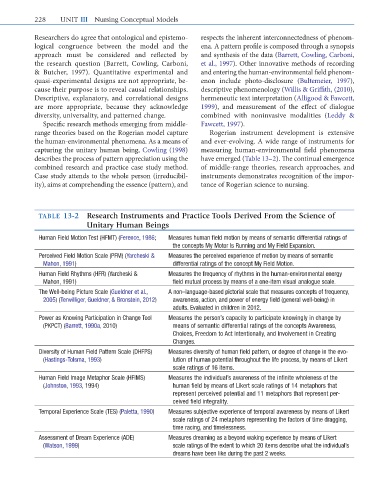
           describes the process of pattern appreciation using the   have emerged (Table 13–2). The continual emergence
           combined  research  and  practice  case  study  method.   of  middle-range  theories,  research  approaches,  and
           Case study attends to the whole person (irreducibil-  instruments demonstrates recognition of the impor-
           ity), aims at comprehending the essence (pattern), and   tance of Rogerian science to nursing.


            TABLE 13-2   Research Instruments and Practice Tools Derived From the Science of
                         Unitary Human Beings
            Human Field Motion Test (HFMT) (Ference, 1986;   Measures human field motion by means of semantic differential ratings of
                                                 the concepts My Motor Is Running and My Field Expansion.
            Perceived Field Motion Scale (PFM) (Yarcheski &   Measures the perceived experience of motion by means of semantic
             Mahon, 1991)                        differential ratings of the concept My Field Motion.
            Human Field Rhythms (HFR) (Yarcheski &    Measures the frequency of rhythms in the human-environmental energy
             Mahon, 1991)                        field mutual process by means of a one-item visual analogue scale.
            The Well-being Picture Scale (Gueldner et al.,   A non–language-based pictorial scale that measures concepts of frequency,
             2005) (Terwilliger, Gueldner, & Bronstein, 2012)  awareness, action, and power of energy field (general well-being) in
                                                 adults. Evaluated in children in 2012.
            Power as Knowing Participation in Change Tool   Measures the person’s capacity to participate knowingly in change by
             (PKPCT) (Barrett, 1990a, 2010)      means of semantic differential ratings of the concepts Awareness,
                                                 Choices, Freedom to Act Intentionally, and Involvement in Creating
                                                 Changes.
            Diversity of Human Field Pattern Scale (DHFPS)   Measures diversity of human field pattern, or degree of change in the evo-
             (Hastings-Tolsma, 1993)             lution of human potential throughout the life process, by means of Likert
                                                 scale ratings of 16 items.
            Human Field Image Metaphor Scale (HFIMS)   Measures the individual’s awareness of the infinite wholeness of the
             (Johnston, 1993, 1994)              human field by means of Likert scale ratings of 14 metaphors that
                                                 represent perceived potential and 11 metaphors that represent per-
                                                 ceived field integrality.
            Temporal Experience Scale (TES) (Paletta, 1990)  Measures subjective experience of temporal awareness by means of Likert
                                                 scale ratings of 24 metaphors representing the factors of time dragging,
                                                 time racing, and timelessness.
            Assessment of Dream Experience (ADE)    Measures dreaming as a beyond waking experience by means of Likert
             (Watson, 1999)                      scale ratings of the extent to which 20 items describe what the individual’s
                                                 dreams have been like during the past 2 weeks.

