


Page 248 - alligood 8th edition_Neat
P. 248
CHAPTER 13  Martha E. Rogers  229

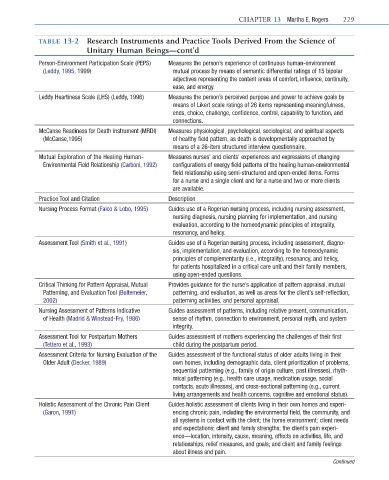
            TABLE 13-2   Research Instruments and Practice Tools Derived From the Science of
                         Unitary Human Beings—cont’d
            Person-Environment Participation Scale (PEPS)   Measures the person’s experience of continuous human-environment
             (Leddy, 1995, 1999)                 mutual process by means of semantic differential ratings of 15 bipolar
                                                 adjectives representing the content areas of comfort, influence, continuity,
                                                 ease, and energy.
            Leddy Heartiness Scale (LHS) (Leddy, 1996)  Measures the person’s perceived purpose and power to achieve goals by
                                                 means of Likert scale ratings of 26 items representing meaningfulness,
                                                 ends, choice, challenge, confidence, control, capability to function, and
                                                 connections.
            McCanse Readiness for Death Instrument (MRDI)   Measures physiological, psychological, sociological, and spiritual aspects
             (McCanse,1995)                      of healthy field pattern, as death is developmentally approached by
                                                 means of a 26-item structured interview questionnaire.
            Mutual Exploration of the Healing Human-   Measures nurses’ and clients’ experiences and expressions of changing
             Environmental Field Relationship (Carboni, 1992)  configurations of energy field patterns of the healing human-environmental
                                                 field relationship using semi-structured and open-ended items. Forms
                                                 for a nurse and a single client and for a nurse and two or more clients
                                                 are available.
            Practice Tool and Citation          Description
            Nursing Process Format (Falco & Lobo, 1995)  Guides use of a Rogerian nursing process, including nursing assessment,
                                                 nursing diagnosis, nursing planning for implementation, and nursing
                                                 evaluation, according to the homeodynamic principles of integrality,
                                                 resonancy, and helicy.
            Assessment Tool (Smith et al., 1991)  Guides use of a Rogerian nursing process, including assessment, diagno-
                                                 sis, implementation, and evaluation, according to the homeodynamic
                                                 principles of complementarity (i.e., integrality), resonancy, and helicy,
                                                 for patients hospitalized in a critical care unit and their family members,
                                                 using open-ended questions.
            Critical Thinking for Pattern Appraisal, Mutual   Provides guidance for the nurse’s application of pattern appraisal, mutual
             Patterning, and Evaluation Tool (Bultemeier,   patterning, and evaluation, as well as areas for the client’s self-reflection,
             2002)                               patterning activities, and personal appraisal.
            Nursing Assessment of Patterns Indicative    Guides assessment of patterns, including relative present, communication,
             of Health (Madrid & Winstead-Fry, 1986)  sense of rhythm, connection to environment, personal myth, and system
                                                 integrity.
            Assessment Tool for Postpartum Mothers    Guides assessment of mothers experiencing the challenges of their first
             (Tettero et al., 1993)              child during the postpartum period.
            Assessment Criteria for Nursing Evaluation of the   Guides assessment of the functional status of older adults living in their
             Older Adult (Decker, 1989)          own homes, including demographic data, client prioritization of problems,
                                                 sequential patterning (e.g., family of origin culture, past illnesses), rhyth-
                                                 mical patterning (e.g., health care usage, medication usage, social
                                                 contacts, acute illnesses), and cross-sectional patterning (e.g., current
                                                 living arrangements and health concerns, cognitive and emotional status).
            Holistic Assessment of the Chronic Pain Client   Guides holistic assessment of clients living in their own homes and experi-
             (Garon, 1991)                       encing chronic pain, including the environmental field, the community, and
                                                 all systems in contact with the client; the home environment; client needs
                                                 and expectations; client and family strengths; the client’s pain experi-
                                                 ence—location, intensity, cause, meaning, effects on activities, life, and
                                                 relationships, relief measures, and goals; and client and family feelings
                                                 about illness and pain.
                                                                                             Continued

