


Page 280 - alligood 8th edition_Neat
P. 280
CHAPTER 15  Imogene M. King  261

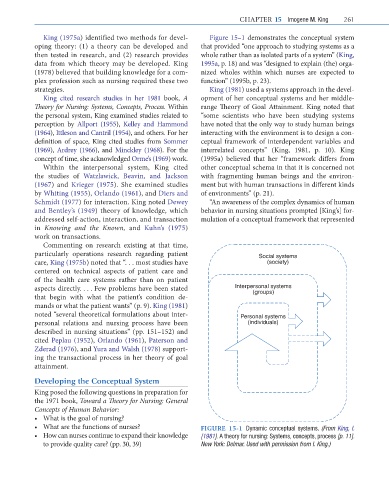
             King (1975a) identified two methods for devel-  Figure 15–1 demonstrates the conceptual system
           oping  theory:  (1)  a  theory  can  be  developed  and   that provided “one approach to studying systems as a
           then tested in research, and (2) research provides   whole rather than as isolated parts of a system” (King,
           data  from  which  theory  may  be  developed.  King   1995a, p. 18) and was “designed to explain (the) orga-
           (1978) believed that building knowledge for a com-  nized  wholes  within  which  nurses  are  expected  to
           plex profession such as nursing required these two   function” (1995b, p. 23).
           strategies.                                     King (1981) used a systems approach in the devel-
             King  cited  research  studies  in  her  1981  book,  A   opment of her conceptual systems and her middle-
           Theory for Nursing: Systems, Concepts, Process. Within   range  Theory  of  Goal  Attainment.  King  noted  that
           the personal system, King examined studies related to   “some  scientists  who  have  been  studying  systems
           perception  by  Allport  (1955),  Kelley  and  Hammond   have noted that the only way to study human beings
           (1964), Ittleson and Cantril (1954), and others. For her   interacting with the environment is to design a con-
           definition  of  space,  King  cited  studies  from  Sommer   ceptual framework of interdependent variables and
           (1969),  Ardrey  (1966),  and  Minckley  (1968).  For  the   interrelated  concepts”  (King,  1981,  p.  10).  King
           concept of time, she acknowledged Orme’s (1969) work.  (1995a)  believed  that  her  “framework  differs  from
             Within  the  interpersonal  system,  King  cited    other conceptual schema in that it is concerned not
           the  studies  of  Watzlawick,  Beavin,  and  Jackson   with  fragmenting  human  beings  and  the  environ-
           (1967)  and  Krieger  (1975).  She  examined  studies   ment but with human transactions in different kinds
           by Whiting (1955), Orlando (1961), and Diers and   of environments” (p. 21).
           Schmidt (1977) for interaction. King noted Dewey   “An awareness of the complex dynamics of human
           and  Bentley’s  (1949)  theory  of  knowledge,  which   behavior in nursing situations prompted [King’s] for-
           addressed self-action, interaction, and transaction   mulation of a conceptual framework that represented
           in  Knowing  and  the  Known,  and  Kuhn’s  (1975)
           work on transactions.
             Commenting  on  research  existing  at  that  time,
           particularly  operations  research  regarding  patient        Social systems
           care, King (1975b) noted that “. . . most studies have          (society)
           centered  on  technical  aspects  of  patient  care  and
           of  the  health  care  systems  rather  than  on  patient
           aspects directly. . . . Few problems have been stated   Interpersonal systems
                                                                       (groups)
           that  begin  with  what  the  patient’s  condition  de-
           mands or what the patient wants” (p. 9). King (1981)
           noted “several theoretical formulations about inter-     Personal systems
           personal  relations  and  nursing  process  have  been     (individuals)
           described in nursing situations” (pp. 151–152) and
           cited Peplau (1952), Orlando (1961), Paterson and
           Zderad (1976), and Yura and Walsh (1978) support-
           ing the transactional process in her theory of goal
           attainment.
           Developing the Conceptual System
           King posed the following questions in preparation for
           the 1971 book, Toward a Theory for Nursing: General
           Concepts of Human Behavior:
           •  What is the goal of nursing?
           •  What are the functions of nurses?          FIGURE  15-1   Dynamic conceptual systems. (From King, I.
           •  How can nurses continue to expand their knowledge   [1981]. A theory for nursing: Systems, concepts, process [p. 11].
             to provide quality care? (pp. 30, 39)       New York: Delmar. Used with permission from I. King.)

