


Page 281 - alligood 8th edition_Neat
P. 281
262    UNIT III  Nursing Conceptual Models

           personal,  interpersonal,  and  social  systems  as  the    that motivated King to develop this theory was, “What
           domain of nursing” (King, 1981, p. 130). Each system   is  the  nature  of  nursing?”  (King,  1995b,  p.  25).  She
           identifies human beings as the basic element in the   noted the answer to be: “the way in which nurses, in
           system, thus “the unit of analysis in [the] framework   their role, do with and for individuals that differentiates
           [was] human behavior in a variety of social environ-  nursing from other health professionals” (King, 1995b,
           ments” (King, 1995a, p. 18). King designated an ex-  p.  26).  This  thinking  guided  her  development  of  the
           ample of a personal system as a patient or a nurse.   Theory of Goal Attainment using the following theory
           King  specified  the  concepts  of  body  image,  growth   development process:
           and development, perception, self, space, and time in   •  “What are the philosophical assumptions?”
           order to comprehend human beings as persons.  •  “Are the concepts clearly identified and defined?”
             Interpersonal systems form when two or more indi-  •  “Are the concepts related in propositional statements
           viduals interact, forming dyads (two people) or triads   or models?”
           (three people). The dyad of a nurse and a patient is one   •  “Does the theory generate questions to be answered
           type of interpersonal system. Families, when acting as   or hypotheses to be tested in research to generate
           small  groups,  also  can  be  considered  interpersonal   knowledge and affirm the theory?”
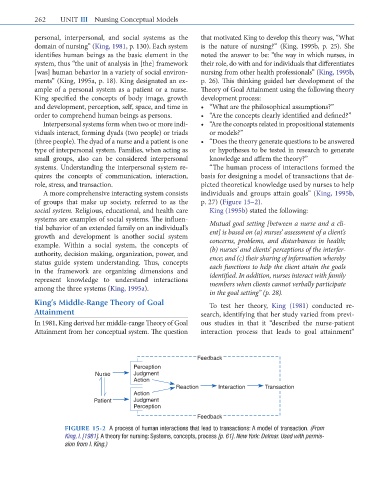
           systems.  Understanding  the  interpersonal  system  re-  “The human process of interactions formed the
           quires  the  concepts  of  communication,  interaction,   basis for designing a model of transactions that de-
           role, stress, and transaction.                picted theoretical knowledge used by nurses to help
             A more comprehensive interacting system consists   individuals and groups attain goals” (King, 1995b,
           of  groups  that  make  up  society,  referred  to  as  the    p. 27) (Figure 15–2).
           social system. Religious, educational, and health care   King (1995b) stated the following:
           systems are examples of social systems. The influen-  Mutual goal setting [between a nurse and a cli-
           tial behavior of an extended family on an individual’s   ent] is based on (a) nurses’ assessment of a client’s
           growth  and  development  is  another  social  system    concerns,  problems,  and  disturbances  in  health;
           example.  Within  a  social  system,  the  concepts  of    (b) nurses’ and clients’ perceptions of the interfer-
           authority, decision making, organization, power, and   ence; and (c) their sharing of information whereby
           status  guide  system  understanding.  Thus,  concepts    each functions to help the client attain the goals
           in  the  framework  are  organizing  dimensions  and    identified. In addition, nurses interact with family
           represent  knowledge  to  understand  interactions   members when clients cannot verbally participate
           among the three systems (King, 1995a).
                                                           in the goal setting” (p. 28).
           King’s Middle-Range Theory of Goal              To  test  her  theory,  King  (1981)  conducted  re-
           Attainment                                    search, identifying that her study varied from previ-
           In 1981, King derived her middle-range Theory of Goal   ous  studies  in  that  it  “described  the  nurse-patient
           Attainment from her conceptual system. The question   interaction  process  that  leads  to  goal  attainment”


                                                        Feedback
                                      Perception
                           Nurse      Judgment
                                      Action
                                                  Reaction    Interaction  Transaction
                                      Action
                           Patient    Judgment
                                      Perception
                                                        Feedback
                   FIGURE 15-2   A process of human interactions that lead to transactions: A model of transaction. (From
                   King, I. [1981]. A theory for nursing: Systems, concepts, process [p. 61]. New York: Delmar. Used with permis-
                   sion from I. King.)

