


Page 64 - alligood 8th edition_Neat
P. 64
CHAPTER 5 NursingTheoristsofHistoricalSignificance 45
Counselor
Unconditional Resource person
Nurse: Stranger Surrogate Leadership Adult person
mother Surrogate:
Mother
Sibling
Patient: Stranger Infant Child Adolescent Adult person
Phases in Orientation Identification
nursing
relationship: Exploitation
Resolution
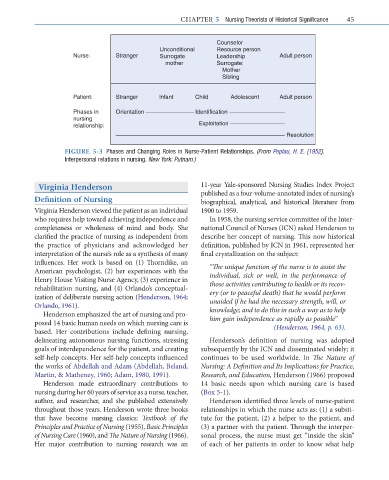
FIGURE 5-3 PhasesandChangingRolesinNurse-PatientRelationships.(From Peplau, H. E. [1952].
Interpersonalrelationsinnursing. New York: Putnam.)
Virginia Henderson 11-year Yale-sponsored Nursing Studies Index Project
published as a four-volume-annotated index of nursing’s
Definition of Nursing biographical, analytical, and historical literature from
Virginia Henderson viewed the patient as an individual 1900 to 1959.
who requires help toward achieving independence and In 1958, the nursing service committee of the Inter-
completeness or wholeness of mind and body. She national Council of Nurses (ICN) asked Henderson to
clarified the practice of nursing as independent from describe her concept of nursing. This now historical
the practice of physicians and acknowledged her definition, published by ICN in 1961, represented her
interpretation of the nurse’s role as a synthesis of many final crystallization on the subject:
influences. Her work is based on (1) Thorndike, an “The unique function of the nurse is to assist the
American psychologist, (2) her experiences with the individual, sick or well, in the performance of
Henry House Visiting Nurse Agency, (3) experience in those activities contributing to health or its recov-
rehabilitation nursing, and (4) Orlando’s conceptual- ery (or to peaceful death) that he would perform
ization of deliberate nursing action (Henderson, 1964; unaided if he had the necessary strength, will, or
Orlando, 1961). knowledge; and to do this in such a way as to help
Henderson emphasized the art of nursing and pro-
posed 14 basic human needs on which nursing care is him gain independence as rapidly as possible”
(Henderson, 1964, p. 63).
based. Her contributions include defining nursing,
delineating autonomous nursing functions, stressing Henderson’s definition of nursing was adopted
goals of interdependence for the patient, and creating subsequently by the ICN and disseminated widely; it
self-help concepts. Her self-help concepts influenced continues to be used worldwide. In The Nature of
the works of Abdellah and Adam (Abdellah, Beland, Nursing: A Definition and Its Implications for Practice,
Martin, & Matheney, 1960; Adam, 1980, 1991). Research, and Education, Henderson (1966) proposed
Henderson made extraordinary contributions to 14 basic needs upon which nursing care is based
nursing during her 60 years of service as a nurse, teacher, (Box 5-1).
author, and researcher, and she published extensively Henderson identified three levels of nurse-patient
throughout those years. Henderson wrote three books relationships in which the nurse acts as: (1) a substi-
that have become nursing classics: Textbook of the tute for the patient, (2) a helper to the patient, and
Principles and Practice of Nursing (1955), Basic Principles (3) a partner with the patient. Through the interper-
of Nursing Care (1960), and The Nature of Nursing (1966). sonal process, the nurse must get “inside the skin”
Her major contribution to nursing research was an of each of her patients in order to know what help

