


Page 72 - alligood 8th edition_Neat
P. 72
CHAPTER 5 NursingTheoristsofHistoricalSignificance 53
Nursing and Midwifery Unit, where she was influen- Jenkins, Solomon, and Whittam (2003) explored the use
tial in developing European Standards for Nursing of the Roper-Logan-Tierney Model of Nursing. They
(Hallett & Wagner, 2011; Roper, 1977). She authored used case studies and exercises about adult patients
The Elements of Nursing in 1980, 1985, and 1990. The with a variety of health problems in acute care and
trio collaborated in the fourth and most recent edi- community-based settings to help students develop
tion of The Elements of Nursing: A Model for Nursing problem-solving skills.
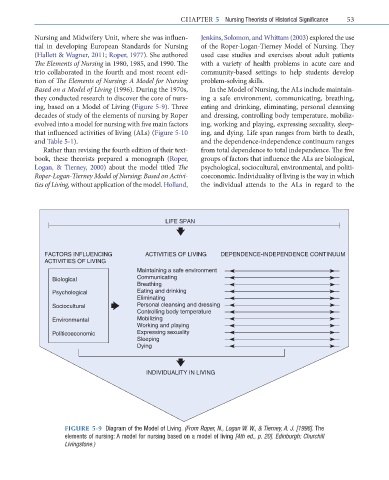
Based on a Model of Living (1996). During the 1970s, In the Model of Nursing, the ALs include maintain-
they conducted research to discover the core of nurs- ing a safe environment, communicating, breathing,
ing, based on a Model of Living (Figure 5-9). Three eating and drinking, eliminating, personal cleansing
decades of study of the elements of nursing by Roper and dressing, controlling body temperature, mobiliz-
evolved into a model for nursing with five main factors ing, working and playing, expressing sexuality, sleep-
that influenced activities of living (ALs) (Figure 5-10 ing, and dying. Life span ranges from birth to death,
and Table 5-1). and the dependence-independence continuum ranges
Rather than revising the fourth edition of their text- from total dependence to total independence. The five
book, these theorists prepared a monograph (Roper, groups of factors that influence the ALs are biological,
Logan, & Tierney, 2000) about the model titled The psychological, sociocultural, environmental, and politi-
Roper-Logan-Tierney Model of Nursing: Based on Activi- coeconomic. Individuality of living is the way in which
ties of Living, without application of the model. Holland, the individual attends to the ALs in regard to the
LIFE SPAN
FACTORS INFLUENCING ACTIVITIES OF LIVING DEPENDENCE-INDEPENDENCE CONTINUUM
ACTIVITIES OF LIVING
Maintaining a safe environment
Biological Communicating
Breathing
Psychological Eating and drinking
Eliminating
Sociocultural Personal cleansing and dressing
Controlling body temperature
Environmental Mobilizing
Working and playing
Politicoeconomic Expressing sexuality
Sleeping
Dying
INDIVIDUALITY IN LIVING
FIGURE 5-9 DiagramoftheModelofLiving.(From Roper, N., Logan W. W., & Tierney, A. J. [1996]. The
elementsofnursing:Amodelfornursingbasedonamodelofliving[4th ed., p. 20]. Edinburgh: Churchill
Livingstone.)

