


Page 73 - alligood 8th edition_Neat
P. 73
54 UNIT I Evolution of Nursing Theories
LIFESPAN
FACTORS INFLUENCING ACTIVITIES OF LIVING DEPENDENCE-INDEPENDENCE CONTINUUM
ACTIVITIES OF LIVING
Maintaining a safe environment
Communicating
Biological
Breathing
Psychological Eating and drinking
Eliminating
Sociocultural Personal cleansing and dressing
Controlling body temperature
Environmental Mobilizing
Working and playing
Politicoeconomic Expressing sexuality
Sleeping
Dying
INDIVIDUALIZING NURSING
Assessing
Planning
Implementing
Evaluating
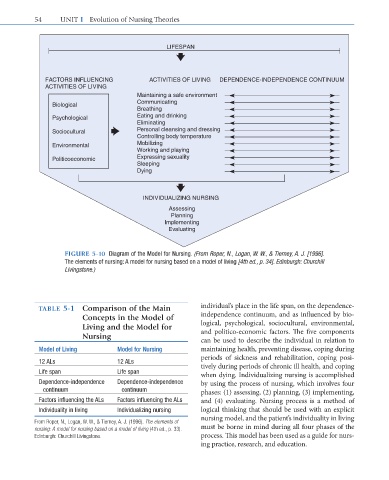
FIGURE 5-10 DiagramoftheModelforNursing.(From Roper, N., Logan, W. W., & Tierney, A. J. [1996].
Theelementsofnursing:Amodelfornursingbasedonamodelofliving[4th ed., p. 34]. Edinburgh: Churchill
Livingstone.)
TABLE 5-1 Comparison of the Main individual’s place in the life span, on the dependence-
Concepts in the Model of independence continuum, and as influenced by bio-
Living and the Model for logical, psychological, sociocultural, environmental,
and politico-economic factors. The five components
Nursing can be used to describe the individual in relation to
Model of Living Model for Nursing maintaining health, preventing disease, coping during
periods of sickness and rehabilitation, coping posi-
12ALs 12ALs tively during periods of chronic ill health, and coping
Lifespan Lifespan when dying. Individualizing nursing is accomplished
Dependence-independence Dependence-independence by using the process of nursing, which involves four
continuum continuum phases: (1) assessing, (2) planning, (3) implementing,
FactorsinfluencingtheALs FactorsinfluencingtheALs and (4) evaluating. Nursing process is a method of
Individualityinliving Individualizingnursing logical thinking that should be used with an explicit
nursing model, and the patient’s individuality in living
From Roper, N., Logan, W. W., & Tierney, A. J. (1996). The elements of
nursing: A model for nursing based on a model of living (4th ed., p. 33). must be borne in mind during all four phases of the
Edinburgh: Churchill Livingstone. process. This model has been used as a guide for nurs-
ing practice, research, and education.

