


Page 14 - MGPI_Case_Study
P. 14
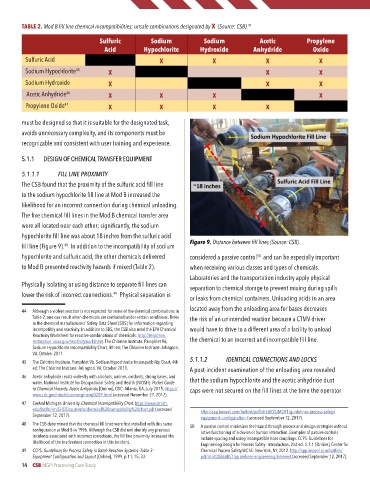
TABLE 2. Mod B fill line chemical incompatibilities; unsafe combinations designated by X  (Source: CSB).
                                                                                   44
                                  Sulfuric         Sodium           Sodium             Acetic          Propylene
                    44
                                    Acid         Hypochlorite      Hydroxide         Anhydride           Oxide
           Sulfuric Acid                              X                X                 X                 X
           Sodium Hypochlorite 45    X                                                   X                 X
         Sodium Hydroxide            X                                                   X                 X

             Acetic Anhydride 46     X                X                X                                   X

           Propylene Oxide 47        X                X                X                 X

        must be designed so that it is suitable for the designated task,
        avoids unnecessary complexity, and its components must be
        recognizable and consistent with user training and experience.

        5.1.1   DESIGN OF CHEMICAL TRANSFER EQUIPMENT

        5.1.1.1     FILL LINE PROXIMITY

        The CSB found that the proximity of the sulfuric acid fill line
        to the sodium hypochlorite fill line at Mod B increased the
        likelihood for an incorrect connection during chemical unloading.
        The five chemical fill lines in the Mod B chemical transfer area
        were all located near each other; significantly, the sodium
        hypochlorite fill line was about 18 inches from the sulfuric acid
                                                                Figure 9. Distance between fill lines (Source: CSB).
        fill line (Figure 9).   In addition to the incompatibility of sodium
                      48
        hypochlorite and sulfuric acid, the other chemicals delivered   considered a passive control   and can be especially important
                                                                                      50
        to Mod B presented reactivity hazards if mixed (Table 2).   when receiving various classes and types of chemicals.

                                                                Laboratories and the transportation industry apply physical
        Physically isolating or using distance to separate fill lines can
                                                                separation to chemical storage to prevent mixing during spills
                                       49
        lower the risk of incorrect connections.   Physical separation is
                                                                or leaks from chemical containers. Unloading acids in an area
                                                                located away from the unloading area for bases decreases
        44   Although a violent reaction is not expected for some of the chemical combinations in
            Table 2, one can result when chemicals are combined under certain conditions. Refer   the risk of an unintended reaction because a CTMV driver
            to the chemical manufacturers’ Safety Data Sheet (SDS) for information regarding
            incompatibly and reactivity. In addition to SDS, the CSB also used the EPA Chemical   would have to drive to a different area of a facility to unload
            Reactivity Worksheet for reactive combinations of chemicals: http://response.
            restoration.noaa.gov/reactivityworksheet. The Chlorine Institute. Pamphlet 96,   the chemical to an incorrect and incompatible fill line.
            Sodium Hypochlorite Incompatibility Chart, 4th ed; The Chlorine Institute: Arlington,
            VA, October 2011.
                                                                5.1.1.2     IDENTICAL CONNECTIONS AND LOCKS
        45   The Chlorine Institute. Pamphlet 96, Sodium Hypochlorite Incompatibility Chart, 4th
            ed; The Chlorine Institute: Arlington, VA, October 2011.   A post-incident examination of the unloading area revealed
        46   Acetic anhydride reacts violently with alcohols, amines, oxidants, strong bases, and
            water. National Institute for Occupational Safety and Health (NIOSH). Pocket Guide  that the sodium hypochlorite and the acetic anhydride dust
            to Chemical Hazards, Acetic Anhydride [Online], CDC: Atlanta, GA, July 2015, https://  caps were not secured on the fill lines at the time the operator
            www.cdc.gov/niosh/ipcsneng/neng0209.html (accessed November 27, 2017).
        47   Central Michigan University. Chemical Incompatibility Chart. https://www.cmich.
            edu/fas/fsr/rm/EHS/Documents/chemical%20compatibility%20chart.pdf (accessed   http://app.knovel.com/hotlink/pdf/id:kt003JMGR1/guidelines-process-safety/
            September 12, 2017).
                                                                   equipment--configuration. (accessed September 12, 2017).
        48   The CSB determined that the chemical fill lines were first installed with this same   50   A passive control minimizes the hazard through process and design strategies without
            configuration at Mod B in 1996. Although the CSB did not identify any previous   active functioning of a device or human interaction. Examples of passive controls
            incidents associated with incorrect corrections, the fill line proximity increased the   include spacing and using incompatible hose couplings. CCPS. Guidelines for
            likelihood of the inadvertent connection in this incident.
                                                                   Engineering Design for Process Safety--Introduction, 2nd ed. 5.1.1  [Online], Center for
        49  CCPS. Guidelines for Process Safety in Batch Reaction Systems--Table 3:   Chemical Process Safety/AIChE: New York, NY, 2012. http://app.knovel.com/hotlink/
            Equipment Configuration and Layout [Online], 1999, p 11, 15, 33.   pdf/id:kt00A68RS1/guidelines-engineering/inherent (accessed September 12, 2017).
        14  CSB MGPI Processing Case Study

