


Page 13 - Hsslive-Plus-One-Physics-Class-Notes-Part-III (1)
P. 13
Heat, Thermodynamics & Kinetic Theory {12} Vinodkumar M, St. Aloysius H.S.S, Elthuruth, Thrissur.
Reversible and Irreversible process
A reversible process is one, which can be retraced in the reverse order an in the opposite sense,
so that it passes exactly through the same state as in the direct process.
Thus during the direct process, if heat is absorbed, during the reverse process, the same amount of
heat is liberated.
Condition for a process to be reversible:
(a) All steps of the process must be infinitely slow. (b).Loss of heat due to friction, viscosity, resistance
etc should be completely absent.(c).The temp and pressure of the system must not change considerably
form the surrounding at any stage.
Actually, no process is perfectly reversible.
Eg:- (1) Slow evaporation of substance in an insulated container. (2) The slow compression of a spring.
(3) Melting and boiling. (4) Ideal case of adiabatic and isothermal process.
Any process, which cannot be retraced in the opposite direction by reversing, controlling factors,
is called an irreversible process.
Eg: (1) Almost all process in nature are irreversible. (2) Rusting of iron, dissolving of soap in water etc.
Carnot’s Engine and Carnot’s cycle
Saeli Carnot developed an ideal heat engine free from all the defects of practical engines. The essential
parts of Carnot’s engine are:
1) Working Substance: It is an ideal gas taken in a cylinder with perfectly insulating walls and a perfectly
conducting base. Cylinder is provided with a tight, smooth and perfectly insulated piston.
2) Source: It is a body of infinite heat capacity kept at a constant high temperature T K.
1
3) Sink: It is a body of infinite heat capacity, kept at a lower temperature T K.
2
4) A perfectly insulating stand: The cylinder may be placed on the source, sink or the stand and may be
moved from one to the other without doing work.
The working substance is subjected to a cycle of changes consisting of two isothermal operations and two
adiabatic operations. Such a cycle is known as Carnot’s cycle.
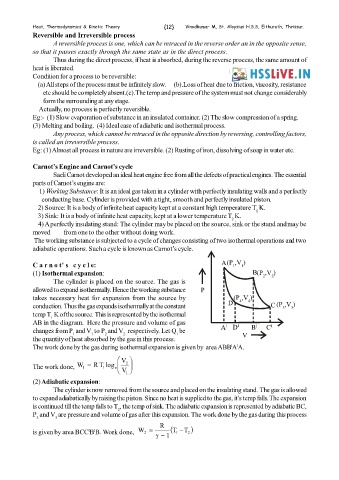
C a r n o t’ s c y c l e: A (P ,V )
1
1
(1) Isothermal expansion: B (P ,V )
2 2
The cylinder is placed on the source. The gas is
allowed to expand isothermally. Hence the working substance P
takes necessary heat for expansion from the source by (P ,V )
D 4 4 (P ,V )
conduction. Thus the gas expands isothermally at the constant C 3 3
temp T K of the source. This is represented by the isothermal
1
AB in the diagram. Here the pressure and volume of gas
A l D l B l C l
changes from P and V to P and V respectively. Let Q be
1 1 2 2 1 V
the quantity of heat absorbed by the gas in this process.
l
l
The work done by the gas during isothermal expansion is given by area ABBAA.
V 2
The work done, W 1 R T 1 log e
V 1
(2) Adiabatic expansion:
The cylinder is now removed from the source and placed on the insulating stand. The gas is allowed
to expand adiabatically by raising the piston. Since no heat is supplied to the gas, it’s temp falls. The expansion
is continued till the temp falls to T , the temp of sink. The adiabatic expansion is represented by adiabatic BC,
2
P and V are pressure and volume of gas after this expansion. The work done by the gas during this process
3 3
R
is given by area BCCB B. Work done, W T T 2
l
l
1
2
1

