


Page 9 - Hsslive-Plus-One-Physics-Class-Notes-Part-III (1)
P. 9
Heat, Thermodynamics & Kinetic Theory {8} Vinodkumar M, St. Aloysius H.S.S, Elthuruth, Thrissur.
Non cyclic porcess: It is a process in which the system doesnot return to its initial state after a series of changes.
Quasistatic process (nearly static process)
It is a process in which a thermodynamic system proceeds extremely slowly such that at every instant of
time, the temperature and pressure are the same in all parts of the system.
Isolated system
It is the system which is completely separated from its surroundings.
o
Q13. Temperature of the human body is 98.4 F. Find the corresponding temperatures of the Celsius and
o
Kelvin Scale. [36.9 C; 309.9 K]
Q14. At what temperature do Celsius and Fahrenheit scales coincide? [-40]
O
Q15. A motor tyre has a pressure of two atmospheres at room temperature of 27 C. If the tyre suddenly
bursts, find the resulting temperature. (= 1.4) [264 K]
Thermal equilibrium and temperature
If a hot body be brought in contact with a cold body, heat energy will be transferred from hot body to cold
body until their temperatures become the same. Thereafter no exchange of heat takes place between them.
At this stage, the two bodies will be at the same temperature and they are said to be in thermal equilibrium
with each other.
Two bodies are said to be in thermal equilibrium with each other, if no exchange of heat takes place
when they are kept in contact with each other.
Zeroth law of thermodynamics
The zeroth law of thermodynamics states that “ If two systems A and B are separately in thermal
equilibrium with a third system C, then A and B are also in thermal equilibrium with one another”.
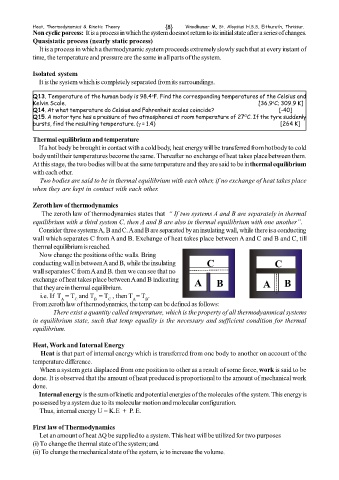
Consider three systems A, B and C. A and B are separated by an insulating wall, while there is a conducting
wall which separates C from A and B. Exchange of heat takes place between A and C and B and C, till
thermal equilibrium is reached.
Now change the positions of the walls. Bring
conducting wall in between A and B, while the insulating C C
wall separates C from A and B. then we can see that no
exchange of heat takes place between A and B indicating A B B
that they are in thermal equilibrium. A
i.e. If T = T and T = T , then T = T .
A C B C A B
From zeroth law of thermodynamics, the temp can be defined as follows:
There exist a quantity called temperature, which is the property of all thermodyanmical systems
in equilibrium state, such that temp equality is the necessary and sufficient condition for thermal
equilibrium.
Heat, Work and Internal Energy
Heat is that part of internal energy which is transferred from one body to another on account of the
temperature difference.
When a system gets displaced from one position to other as a result of some force, work is said to be
done. It is observed that the amount of heat produced is proportional to the amount of mechanical work
done.
Internal energy is the sum of kinetic and potential energies of the molecules of the system. This energy is
possessed by a system due to its molecular motion and molecular configuration.
Thus, internal energy U = K.E + P. E.
First law of Thermodynamics
Let an amount of heat Q be supplied to a system. This heat will be utilized for two purposes
(i) To change the thermal state of the system; and
(ii) To change the mechanical state of the system, ie to increase the volume.

