


Page 113 - Class-11-Physics-Part-1_Neat
P. 113
LAWS OF MOTION                                                                              99

                The total momentum of an isolated system
                of interacting particles is conserved.
                An important example of the application of the
                law of conservation of momentum is the collision
                of two bodies. Consider two bodies A and B, with
                initial momenta p  and p . The bodies collide,
                                 A       B
                get apart, with final momenta p′     and p′
                                                   A        B
                respectively. By the Second Law
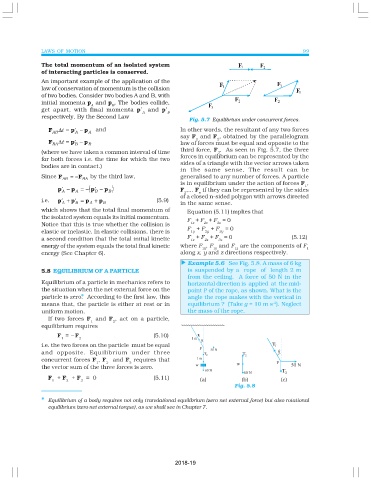
                                                                    Fig. 5.7  Equilibrium under concurrent forces.
                  F    t ∆ =  p′ −  p  and                       In other words, the resultant of any two forces
                    AB      A   A

                                                                 say F  and F , obtained by the parallelogram
                                                                      1
                                                                              2
                  F    t ∆ =  p′ −  p
                    BA     B    B                                law of forces must be equal and opposite to the
                (where we have taken a common interval of time   third force, F .  As seen in Fig. 5.7, the three
                                                                              3
                                                                 forces in equilibrium can be represented by the
                for both forces i.e. the time for which the two
                                                                 sides of a triangle with the vector arrows taken
                bodies are in contact.)
                                                                 in the same sense. The result can be
                Since F   = − F   by the third law,              generalised to any number of forces. A particle
                       AB     BA
                                                                 is in equilibrium under the action of forces F ,
                                                                                                             1
                     p ′ − p A  =  ( − p ′ − p B )               F ,... F  if they can be represented by the sides
                       A
                                   B
                                                                        n
                                                                  2
                                                                 of a closed n-sided polygon with arrows directed
                i.e.  p ′ + ′ =p B  p A  + p B           (5.9)   in the same sense.
                       A
                which shows that the total final momentum of       Equation (5.11) implies that
                the isolated system equals its initial momentum.
                                                                   F + F + F  = 0
                Notice that this is true whether the collision is   1x   2x   3x
                                                                   F  + F  + F  = 0
                elastic or inelastic. In elastic collisions, there is  1y  2y  3y
                a second condition that the total initial kinetic  F  + F  + F  = 0                        (5.12)
                                                                         2z
                                                                              3z
                                                                    1z
                energy of the system equals the total final kinetic  where F , F  and F  are the components of F
                                                                         1x  1y     1z                        1
                energy (See Chapter 6).                          along x, y and z directions respectively.
                                                                    Example 5.6   See Fig. 5.8. A mass of 6 kg
                                                                   t
                5.8  EQUILIBRIUM OF A PARTICLE                      is suspended by a  rope  of  length 2 m
                                                                    from the ceiling.  A force of 50 N in the
                Equilibrium of a particle in mechanics refers to    horizontal direction is  applied  at  the mid-
                the situation when the net external force on the    point P of the rope, as shown. What is the
                particle is zero.*  According to the first law, this  angle the rope makes with the vertical in
                                                                                                  -2
                means that, the particle is either at rest or in    equilibrium ?  (Take g = 10 m s ). Neglect
                uniform motion.                                     the mass of the rope.
                  If two forces F  and F , act on a particle,
                                 1       2
                equilibrium requires
                     F = − F                           (5.10)
                       1       2
                i.e. the two forces on the particle  must be equal
                and opposite. Equilibrium under three
                concurrent forces F , F   and F  requires that
                                   1   2       3
                the vector sum of the three forces is zero.
                  F   + F   + F   =  0                                  (5.11)
                   1     2    3                                         (a)            (b)           (c)
                                                                                    Fig. 5.8
                * Equilibrium of a body requires not only translational equilibrium (zero net external force) but also rotational
                  equilibrium (zero net external torque), as we shall see in Chapter 7.


                                                               2018-19

