


Page 112 - Class-11-Physics-Part-1_Neat
P. 112
98                                                                                     PHYSICS

                                                                        magnitude of force cannot be ascertained since
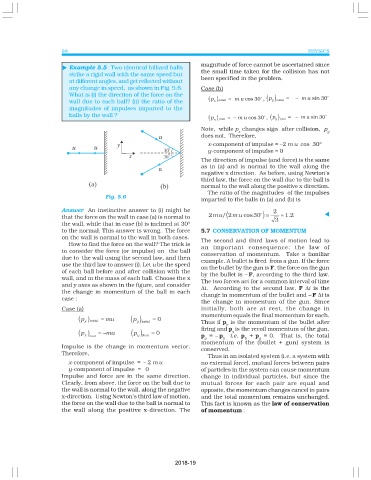
                          Example 5.5  Two identical billiard balls
                         t
                          strike a rigid wall with the same speed but   the small time taken for the collision has not
                          at different angles, and get reflected without  been specified in the problem.
                          any change in speed,  as shown in Fig. 5.6.   Case (b)
                          What is (i) the direction of the force on the                         p     =     −   m u  sin 30
                                                                            p
                          wall due to each ball? (ii) the ratio of the     ( )initial =   m u  cos 30 , ( ) initialy
                                                                             x
                          magnitudes of impulses imparted to   the
                          balls by the wall ?

                                                                                                 p
                                                                            p
                                                                           ( ) final =   – m u  cos 30 , ( ) final = −   m u  sin 30

                                                                                                   y
                                                                             x
                                                                        Note,  while p  changes sign  after collision,  p
                                                                                     x                               y
                                                                        does not.  Therefore,
                                                                           x-component of impulse = –2 m u  cos  30°
                                                                           y-component of impulse = 0
                                                                        The direction of impulse (and force) is the same
                                                                        as in (a) and is normal to the wall along the
                                                                        negative x direction.  As before, using Newton’s
                                                                        third law, the force on the wall due to the ball is
                                                                        normal to the wall along the positive x direction.
                                                                           The ratio of the magnitudes  of the impulses
                                         Fig. 5.6
                                                                        imparted to the balls in (a) and (b) is
                       Answer  An instinctive answer to (i) might be                              2
                       that the force on the wall in case (a) is normal to  2m u / (2m u  cos30   ) =  3  ≈  1.2          t
                       the wall, while that in case (b) is inclined at 30°
                       to the normal. This answer is wrong.  The force  5.7  CONSERVATION OF MOMENTUM
                       on the wall is normal to the wall in both cases.  The second and third laws of motion lead to
                         How to find the force on the wall? The trick is
                       to consider the force (or impulse) on  the ball  an important consequence: the law of
                                                                        conservation of momentum.
                                                                                                      Take a familiar
                       due to  the wall using the second law, and then  example. A bullet is fired  from a gun. If the force
                       use the third law to answer (i). Let u be the speed  on the bullet by the gun is F, the force on the gun
                       of each ball before and after collision with the  by the bullet is – F, according to the third law.
                       wall, and m the mass of each ball. Choose the x  The two forces act for a common interval of time
                       and y axes as shown in the figure, and consider  ∆t.  According to the second law, F  ∆t  is the
                       the change in momentum of the ball in each       change in momentum of the bullet and – F ∆t is
                       case :
                                                                        the change in momentum of the gun. Since
                       Case (a)                                         initially, both are at rest, the change in
                                                                        momentum equals the final momentum for each.
                              p
                             ( ) initial =  mu           p  =  0
                                                                        Thus if p  is the momentum of the bullet after
                                               ( ) initialy
                               x
                                                                                 b
                                                                        firing and p is the recoil momentum of the gun,
                             ( )    = − mu           p  =  0                       g
                              p
                               x
                                                ( ) finaly
                                                                        p
                                 final
                                                                         g  = – p b  i.e.  p b  +  p g  = 0.  That is, the total
                                                                        momentum of the (bullet +     gun)  system is
                       Impulse is the change in momentum vector.
                                                                        conserved.
                       Therefore,
                                                                           Thus in an isolated system (i.e. a system with
                         x-component of impulse  =  – 2 m u             no external force), mutual forces between pairs
                         y-component of impulse  =   0                  of particles in the system can cause momentum
                       Impulse and force are in the same direction.     change in individual particles, but since the
                       Clearly, from above, the force on the ball due to  mutual forces for each pair are equal and
                       the wall is normal to the wall, along the negative  opposite, the momentum changes cancel in pairs
                       x-direction.  Using Newton’s third law of motion,  and the total momentum remains unchanged.
                       the force on the wall due to the ball is normal to  This fact is known as the law of conservation
                       the wall along the positive x-direction. The     of momentum :


                                                               2018-19

