


Page 115 - Class-11-Physics-Part-1_Neat
P. 115
LAWS OF MOTION                                                                             101

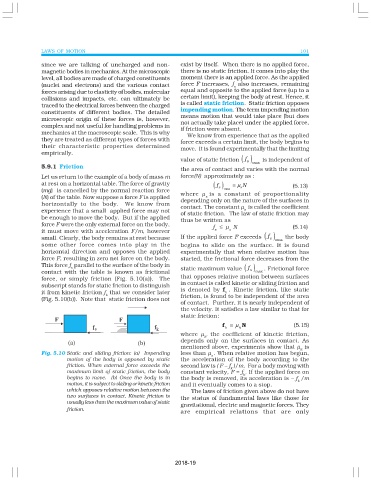
                since we are talking of uncharged and non-       exist by itself.  When there is no applied force,
                magnetic bodies in mechanics. At the microscopic  there is no static friction. It comes into play the
                level, all bodies are made of charged constituents  moment there is an applied force. As the applied
                (nuclei and electrons) and the various contact   force F increases, f  also increases, remaining
                                                                                    s
                forces arising due to elasticity of bodies, molecular  equal and opposite to the applied force (up to a
                collisions and impacts, etc.  can ultimately be  certain limit), keeping the body at rest. Hence, it
                                                                 is called static friction.  Static friction opposes
                traced to the electrical forces between the charged
                                                                 impending motion. The term impending motion
                constituents of different bodies. The detailed
                                                                 means motion that would take place (but does
                microscopic origin of these forces is, however,  not actually take place) under the applied force,
                complex and not useful for handling problems in
                                                                 if friction were absent.
                mechanics at the macroscopic scale.  This is why   We know from experience that as the applied
                they are treated as different types of forces with  force exceeds a certain limit, the body begins to
                their characteristic properties determined       move.  It is found experimentally that the limiting
                empirically.
                                                                 value of static friction ( )   is independent of
                                                                                        f
                                                                                        s
                                                                                          max
                5.9.1  Friction
                                                                 the area of contact and varies with the normal
                Let us return to the example of a body of mass m  force(N)  approximately as :
                at rest on a horizontal table. The force of gravity          ( )   = µ s N               (5.13)
                                                                              f
                                                                              s
                                                                                max
                (mg)  is cancelled by the normal reaction force  where µ is a constant of proportionality
                (N) of the table. Now suppose a force F is applied        s
                                                                 depending only on the nature of the surfaces in
                horizontally to the body.    We know from        contact. The constant µ  is called the coefficient
                experience that a small  applied force may not                         s
                                                                 of static friction.  The law of static friction may
                be enough to move the body.  But if the applied
                                                                 thus be written as
                force F were the only external force on the body,
                                                                            f   ≤  µ  N                  (5.14)
                it must move with acceleration F/m, however                  s    s
                                                                                                f
                small. Clearly, the body remains at rest because  If the applied force F exceeds ( ) max    the body
                                                                                                 s
                some other force comes into play in the          begins to slide on the surface. It is found
                horizontal direction and opposes the applied     experimentally that when relative motion has
                force F, resulting in zero net force on the body.  started, the frictional force decreases from the
                This force f  parallel to the surface of the body in
                                                                                         f
                          s                                      static maximum value ( )      . Frictional force
                                                                                          s
                contact with the table is known as frictional                              max
                force, or simply friction (Fig. 5.10(a)).  The   that opposes relative motion between surfaces
                                                                 in contact is called kinetic or sliding friction and
                subscript stands for static friction to distinguish
                it from kinetic friction f  that we consider later  is denoted by f . Kinetic friction, like static
                                                                                 k
                                      k                          friction, is found to be independent of the area
                (Fig. 5.10(b)).  Note that  static friction does not
                                                                 of contact.  Further, it is nearly independent of
                                                                 the velocity. It satisfies a law similar to that for
                                                                 static friction:
                                                                                f k  = µ k N             (5.15)
                                                                 where µ    the coefficient of kinetic friction,
                                                                         k′
                                                                 depends only on the surfaces in contact. As
                                                                 mentioned above, experiments show that µ  is
                                                                                                           k
                Fig. 5.10 Static and sliding friction: (a)  Impending  less than µ . When relative motion has begun,
                                                                            s
                         motion of the body is opposed by static  the acceleration of the body according to the
                         friction. When external force exceeds the  second law is ( F – f )/m.  For a body moving with
                                                                                   k
                         maximum limit of static friction, the body  constant velocity, F = f . If the applied force on
                                                                                       k
                         begins to move.  (b) Once the body is in  the body is removed, its acceleration is – f /m
                                                                                                          k
                         motion, it is subject to sliding or kinetic friction  and it eventually comes to a stop.
                         which opposes relative motion between the         The laws of friction given above do not have
                         two surfaces in contact. Kinetic friction is  the status of fundamental laws like those for
                         usually less than the maximum value of static
                                                                 gravitational, electric and magnetic forces. They
                         friction.
                                                                 are empirical relations that are only

                                                               2018-19

