


Page 114 - Class-11-Physics-Part-1_Neat
P. 114
100                                                                                    PHYSICS

                       Answer  Figures 5.8(b) and 5.8(c) are known as   other types of supports), there are mutual
                       free-body diagrams. Figure 5.8(b) is the free-body  contact forces (for each pair of bodies) satisfying
                       diagram of W and Fig. 5.8(c) is the free-body    the third law.  The component of contact force
                       diagram of point P.                              normal to the surfaces in contact is called
                         Consider the equilibrium of the weight W.      normal reaction.  The component parallel to the
                       Clearly,T  = 6 × 10 = 60 N.                      surfaces in contact is called friction.  Contact
                                2
                                                                        forces arise also when solids are in contact with
                         Consider the equilibrium of the point P under
                       the action of three forces - the tensions T  and  fluids.  For example, for a solid immersed in a
                                                               1        fluid, there is an upward bouyant force equal to
                       T , and the horizontal force 50 N.  The horizontal
                        2
                       and vertical components of the resultant force   the weight of the fluid displaced. The viscous
                       must vanish separately :                         force, air resistance, etc are also examples of
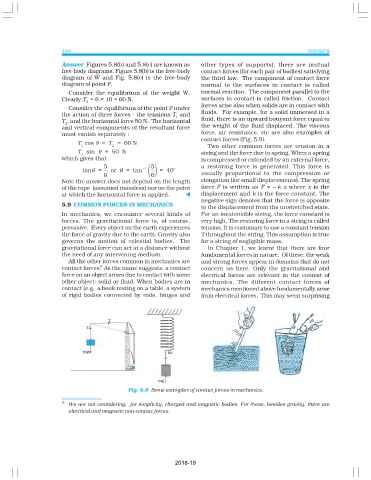
                                                                        contact forces (Fig. 5.9).
                             T  cos θ  =  T   =  60 N
                              1          2                                 Two other common forces are tension in a
                             T   sin  θ   =  50  N                      string and the force due to spring. When a spring
                              1
                       which gives that                                 is compressed or extended by an external force,
                                                                        a restoring force is generated. This force is
                                                                        usually proportional to the compression or
                       Note the answer does not depend on the length    elongation (for small displacements). The spring
                       of the rope  (assumed massless) nor on the point  force F  is written as F = – k x  where x  is the
                       at which the horizontal force is applied.   t    displacement and k is the force constant. The
                                                                        negative sign denotes that the force is opposite
                       5.9  COMMON FORCES IN MECHANICS
                                                                        to the displacement from the unstretched state.
                       In mechanics, we encounter several kinds of      For an inextensible string, the force constant is
                       forces. The gravitational force is, of course,   very high. The restoring force in a string is called
                       pervasive.  Every object on the earth experiences  tension. It is customary to use a constant tension
                       the force of gravity due to the earth. Gravity also  T throughout the string. This assumption is true
                       governs the motion of celestial bodies.   The    for a string of negligible mass.
                       gravitational force can act at a distance without   In Chapter 1, we learnt that there are four
                       the need of any intervening medium.              fundamental forces in nature.  Of these, the weak
                         All the other forces common in mechanics are   and strong forces appear in domains that do not
                       contact forces.* As the name suggests, a contact  concern us here. Only the gravitational and
                       force on an object arises due to contact with some  electrical forces are relevant in the context of
                       other object: solid or fluid. When bodies are in  mechanics. The different contact forces of
                       contact (e.g.  a book resting on a table, a system  mechanics mentioned above fundamentally arise
                       of rigid bodies connected by rods, hinges and    from electrical forces.  This may seem surprising


                                              Fig. 5.9  Some examples of contact forces in mechanics.

                       * We are not considering,  for simplicity, charged and magnetic bodies. For these, besides gravity, there are
                         electrical and magnetic non-contact forces.


                                                               2018-19

