


Page 116 - Class-11-Physics-Part-1_Neat
P. 116
102                                                                                    PHYSICS

                       approximately true.  Yet they are very useful in  Answer  The forces acting on a block of mass m
                       practical calculations in mechanics.             at rest on an inclined plane are (i) the weight
                         Thus, when two bodies are in contact, each     mg acting vertically downwards (ii) the normal
                       experiences a contact force by the other. Friction,  force N of the plane on the block, and (iii) the
                       by definition, is the component of the contact force  static frictional force f  opposing the impending
                                                                                             s
                       parallel to the surfaces in contact, which opposes  motion. In equilibrium, the resultant of these
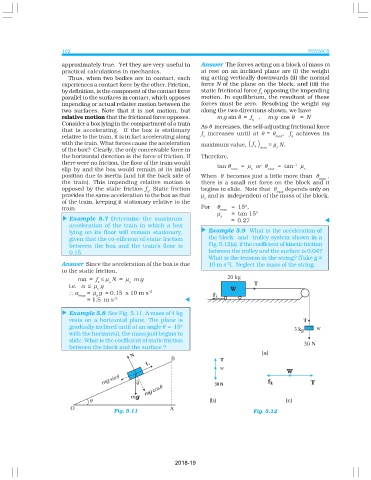
                       impending or actual relative motion between the  forces must be zero.  Resolving the weight mg
                       two surfaces. Note that it is not motion, but    along the two directions shown, we have
                       relative motion that the frictional force opposes.     m g sin θ  =  f    ,     m g  cos θ    =  N
                                                                                          s
                       Consider a box lying in the compartment of a train  As θ  increases, the self-adjusting frictional force
                       that is accelerating.  If the box is stationary
                       relative to the train, it is in fact accelerating along  f s  increases until at θ  = θ max ,  f s  achieves its
                       with the train. What forces cause the acceleration  maximum value, ( )   = µ  N.
                                                                                          f
                                                                                           s
                       of the box?  Clearly, the only conceivable force in                   max   s
                       the horizontal direction is the force of friction. If  Therefore,
                       there were no friction, the floor of the train would   tan θ    =  µ   or  θ    =  tan   µ
                                                                                                         –1
                       slip by and the box would remain at its initial             max    s     max          s
                       position due to inertia (and hit the back side of  When  θ  becomes just a little more than  θ   ,
                                                                                                                  max
                       the train). This impending relative motion is    there is a small net force on the block and it
                       opposed by the static friction f . Static friction  begins to slide.  Note that  θ   depends only on
                                                     s                                             max
                       provides the same acceleration to the box as that  µ  and is  independent of the mass of the block.
                                                                         s
                       of the train, keeping it stationary relative to the
                       train.                                           For   θ max    =  15°,
                                                                              µ       =  tan 15°
                          Example 5.7 Determine the maximum                    s    =  0.27                         t
                         t
                          acceleration of the train in which a box
                          lying on its floor will remain stationary,      t  Example 5.9  What is the acceleration of
                          given that the co-efficient of static friction   the block  and  trolley system shown in a
                          between the box and the train’s floor is         Fig. 5.12(a), if the coefficient of kinetic friction
                          0.15.                                            between the trolley and the surface is 0.04?
                                                                           What is the tension in the string? (Take g =
                       Answer  Since the acceleration of the box is due    10 m s ).  Neglect the mass of the string.
                                                                                 -2
                       to the static friction,
                             ma  =  f  ≤ µ  N  =  µ   m g
                                    s   s      s
                         i.e.   a  ≤  µ  g
                                   s
                         ∴ a    =  µ g  = 0.15  x 10 m s –2
                             max   s
                                = 1.5  m s –2                       t
                          Example 5.8  See Fig. 5.11. A mass of 4 kg
                         t
                          rests on a horizontal plane. The plane is
                          gradually inclined until at an angle θ  =  15°
                          with the horizontal, the mass just begins to
                          slide. What is the coefficient of static friction
                          between the block and the surface ?
                                                                                              (a)


                                                                           (b)                        (c)
                                         Fig. 5.11                                         Fig. 5.12


                                                               2018-19

