


Page 141 - Class-11-Physics-Part-1_Neat
P. 141
WORK, ENERGY AND POWER                                                                     127

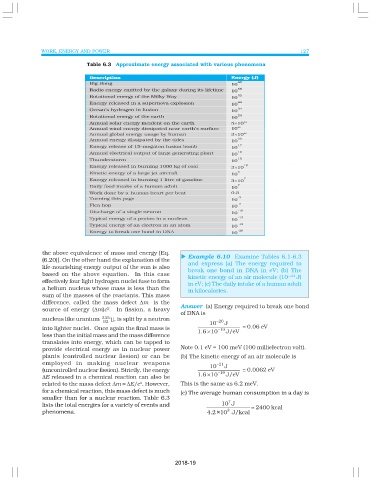
                                Table 6.3   Approximate energy associated with various phenomena


                the above equivalence of mass and energy [Eq.
                (6.20)]. On the other hand the explanation of the  t  Example 6.10  Examine Tables 6.1-6.3
                                                                    and express (a) The energy required to
                life-nourishing energy output of the sun is also    break one bond in DNA in eV; (b) The
                based on the above equation.     In this case       kinetic energy of an air molecule (10 —21  J)
                effectively four light hydrogen nuclei fuse to form  in eV; (c) The daily intake of a human adult
                a helium nucleus whose mass is less than the        in kilocalories.
                sum of the masses of the reactants. This mass
                difference, called the mass defect ∆m  is the
                                                                 Answer  (a) Energy required to break one bond
                                       2
                source of energy (∆m)c .  In fission, a heavy
                                                                 of DNA is
                nucleus like uranium  235 U , is split by a neutron
                                       92                                     − 20
                                                                           10    J
                into lighter nuclei.  Once again the final mass is     1.6 10 − 19  J/eV    ~  0.06 eV
                                                                          ×
                less than the initial mass and the mass difference
                translates into energy, which can be tapped to
                provide electrical energy as in nuclear power    Note 0.1 eV = 100 meV (100 millielectron volt).
                plants (controlled nuclear fission) or can be    (b) The kinetic energy of an air molecule is
                employed in making nuclear weapons                         10 − 21 J
                (uncontrolled nuclear fission). Strictly, the energy          − 19     ~ 0.0062 eV
                                                                          ×
                ∆E released in a chemical reaction can also be         1.6 10    J/eV
                related to the mass defect ∆m = ∆E/c . However,  This is the same as 6.2 meV.
                                                   2
                for a chemical reaction, this mass defect is much  (c) The average human consumption in a day is
                smaller than for a nuclear reaction. Table 6.3                    7
                lists the total energies for a variety of events and           10 J       ~ 2400 kcal
                phenomena.                                                4.2×10 3  J/kcal


                                                               2018-19

