


Page 139 - Class-11-Physics-Part-1_Neat
P. 139
WORK, ENERGY AND POWER                                                                     125

                                           4
                                       = 1.25 × 10  J
                We obtain
                              x  = 2.00 m
                               m
                We note that we have idealised the situation.
                The spring is considered to be massless. The
                surface has been considered to possess
                negligible friction.                       t
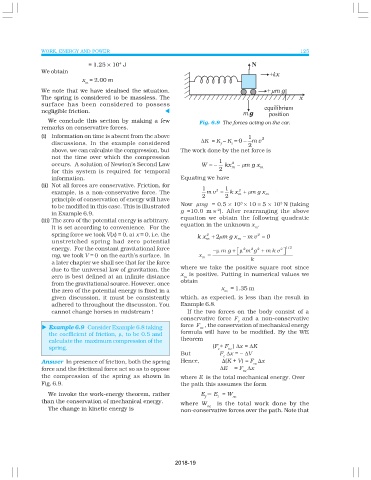
                  We conclude this section by making a few              Fig. 6.9  The forces acting on the car.
                remarks on conservative forces.
                (i) Information on time is absent from the above                         1    2
                   discussions. In the example considered               ∆K  = K  − K  0=   −   2 m  v
                                                                                   i
                                                                               f
                   above, we can calculate the compression, but  The work done by the net force is
                   not the time over which the compression                     1
                                                                             −
                                                                           =
                                                                                     −
                                                                                   2
                   occurs.  A solution of Newton’s Second Law           W        kx     m g x m
                                                                                       µ
                                                                                   m
                   for this system is required for temporal                    2
                   information.                                  Equating we have
                (ii) Not all forces are conservative. Friction, for
                                                                         1    2  1   2
                   example, is a non-conservative force. The              m v =    k x  m  +   m g x  m
                                                                                         µ
                                                                         2       2
                   principle of conservation of energy will have                      3             3
                   to be modified in this case. This is illustrated  Now  µmg  = 0.5 × 10 × 10 = 5 × 10 N (taking
                                                                              -2
                                                                 g  =10.0 m s ). After rearranging the above
                   in Example 6.9.
                                                                 equation we obtain the following quadratic
                (iii) The zero of the potential energy is arbitrary.
                                                                 equation in the unknown x .
                   It is set according to convenience.  For the                            m
                   spring force we took V(x) = 0, at x = 0, i.e. the      2  +         −  m v =
                                                                                            2
                                                                       k x  m  2 m g x  m      0
                                                                               µ
                   unstretched spring had zero potential
                   energy.  For the constant gravitational force
                   mg, we took V = 0  on the earth’s surface.  In
                   a later chapter we shall see that for the force
                   due to the universal law of gravitation, the  where we take the positive square root since
                   zero is best defined at an infinite distance  x  is positive. Putting in numerical values we
                                                                  m
                   from the gravitational source. However, once  obtain
                   the zero of the potential energy is fixed in a              x   = 1.35 m
                                                                                m
                   given discussion, it must be consistently     which, as expected, is less than the result in
                   adhered to throughout the discussion. You     Example 6.8.
                   cannot change horses in midstream !             If the two forces on the body consist of a
                                                                 conservative force F  and a non-conservative
                                                                                     c
                  Example 6.9   Consider Example 6.8 taking      force  F  , the conservation of mechanical energy
                                                                        nc
                  t
                  the coefficient of friction, µ, to be 0.5 and  formula will have to be modified. By the WE
                  calculate the  maximum compression of the      theorem
                  spring.                                                   (F + F ) ∆x = ∆K
                                                                                  nc
                                                                              c
                                                                 But            F  ∆x = − ∆V
                                                                                c
                Answer  In presence of friction, both the spring  Hence,             ∆(K + V) = F ∆x
                                                                                           nc
                force and the frictional force act so as to oppose                         ∆E    = F ∆x
                                                                                       nc
                the compression of the spring as shown in        where E  is the total mechanical energy. Over
                Fig. 6.9.                                        the path this assumes the form
                  We invoke the work-energy theorem, rather             E  −− −− − E   = W
                                                                          f   i    nc
                than the conservation of mechanical energy.
                                                                 where W  nc  is the total work done by the
                  The change in kinetic energy is                non-conservative forces over the path. Note that

                                                               2018-19

