


Page 138 - Class-11-Physics-Part-1_Neat
P. 138
124                                                                                    PHYSICS

                                                    2
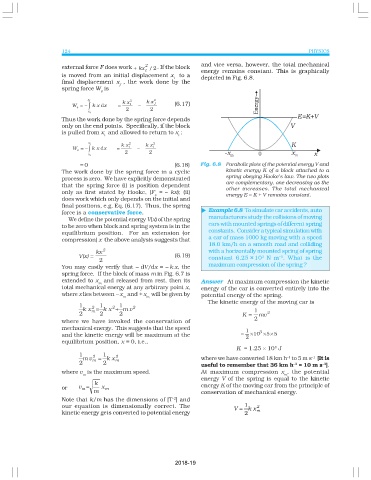
                       external force F does work  + kx / 2 . If the block  and vice versa, however, the total mechanical
                                                    c                   energy remains constant. This is graphically
                       is moved from an initial displacement x   to a
                                                              i         depicted in Fig. 6.8.
                       final displacement x  , the work done by the
                                           f
                       spring force W  is
                                     s
                                x f         k x  2   k x  2
                                     d
                            W = − ∫  k x  x   =  2  i      −     2  f              (6.17)
                            s
                                x i
                       Thus the work done by the spring force depends
                       only on the end points.  Specifically, if the block
                       is pulled from x   and allowed to return to x  ;
                                      i                         i
                                x i         k x  2   k x  2
                              W = − ∫  k x  x       =d  i      −     i
                            s
                                             2        2
                                x i
                                = 0                            (6.18)   Fig. 6.8 Parabolic plots of the potential energy V and
                       The work done by the spring force in a cyclic             kinetic energy K of a block attached to a
                       process is zero.  We have explicitly demonstrated         spring obeying Hooke’s law. The two plots
                       that the spring force (i) is position dependent           are complementary, one decreasing as the
                                                                                 other increases. The total mechanical
                       only as first stated by Hooke, (F  = −  kx); (ii)
                                                        s                        energy E = K + V remains constant.
                       does work which only depends on the initial and
                       final positions, e.g. Eq. (6.17).  Thus, the spring
                       force is a conservative force.                     t  Example 6.8  To simulate car accidents, auto
                         We define the potential energy V(x) of the spring  manufacturers study the collisions of moving
                       to be zero when block and spring system is in the   cars with mounted springs of different spring
                       equilibrium position.   For an extension (or        constants.  Consider a typical simulation with
                       compression) x  the above analysis suggests that    a car of mass 1000 kg moving with a speed
                                                                           18.0 km/h on a smooth road and colliding
                                   kx 2                                    with a horizontally mounted spring of spring
                             V(x) =                            (6.19)      constant 6.25  ×  10 3  N m .  What is the
                                                                                                    –1
                                    2
                       You may easily verify that −  dV/dx =  − k x, the   maximum compression of the spring ?
                       spring force.  If the block of mass m in Fig. 6.7 is
                       extended to x  and released from rest, then its  Answer   At maximum compression the kinetic
                                    m
                       total mechanical energy at any arbitrary point x,  energy of the car is converted entirely into the
                       where x lies between – x  and + x  will be given by  potential energy of the spring.
                                            m        m,
                                                                           The kinetic energy of the moving car is
                             1   2 1     2 1    2
                                x   k  m  =  x   k  +  m  v                                1
                             2      2      2                                           K =   mv 2
                       where we have invoked the conservation of                           2
                       mechanical energy.  This suggests that the speed                 1    3
                       and the kinetic energy will be maximum at the                      =  2  × 10 × 5 × 5
                       equilibrium position, x = 0, i.e.,
                                                                                          K  = 1.25 × 10  J
                                                                                                  4
                             1    2  1    2
                                                                                                               –1
                                                                                                       –1
                              m  v    m  =    x   k  m                  where we have converted 18 km h  to 5 m s   [It is
                             2        2                                 useful to remember that 36 km h  = 10 m s ].
                                                                                                                   –1
                                                                                                         –1
                       where v  is the maximum speed.                   At maximum compression x , the potential
                              m                                                                       m
                                                                        energy V of the spring is equal to the kinetic
                                  k                                     energy K of the moving car from the principle of
                       or    v =     x    m
                              m
                                  m                                     conservation of mechanical energy.
                       Note that k/m has the dimensions of [T ] and
                                                              -2
                       our equation is dimensionally correct. The                   V  =   1  x   k  2
                       kinetic energy gets converted to potential energy                2   m


                                                               2018-19

