


Page 136 - Class-11-Physics-Part-1_Neat
P. 136
122                                                                                    PHYSICS

                         The total mechanical energies E , E , and E    Answer  (i)  There are two external forces on
                                                        0   h      H
                       of the ball at the indicated heights zero (ground  the bob : gravity and the tension (T ) in the
                       level), h and H, are                             string. The latter does no work since the
                                                                        displacement of the bob is always normal to the
                             E    = mgH                                 (6.11 a)
                              H                                         string. The potential energy of the bob is thus
                                        1
                             E =  mgh +   mv  2              (6.11 b)   associated with the gravitational force only. The
                              h
                                        2    h                          total mechanical energy E    of the system is
                             E  = (1/2) mv  2                (6.11 c)
                              0           f                             conserved.  We take the potential energy of the
                       The constant force is a special case of a spatially  system to be zero at the lowest point A. Thus,
                       dependent force F(x). Hence, the mechanical      at A :
                       energy is conserved.  Thus
                              E  = E
                               H    0                                               1   2
                                    1   2                                       E =  mv 0                       (6.12)
                       or,   mgH =   mv  f                                          2
                                    2
                             v =   2gH                                                       [Newton’s Second Law]
                              f
                       a result that was obtained in section 3.7 for a  where T  is the tension  in the string at A. At the
                                                                                A
                       freely falling body.                             highest point C, the string slackens, as the
                       Further,                                         tension in the string (T ) becomes zero.
                              E  = E                                                          C
                               H    h                                   Thus, at C
                       which implies,
                               2                                               1
                                                                                    2
                              v h  =  2 g(H −  h)                 (6.11 d)  E =  mv +  2mgL                     (6.13)
                                                                                   c
                       and is a familiar result from kinematics.               2
                         At the height H, the energy is purely potential.       mv 2
                       It is partially converted to kinetic at height h  and  mg=  L c      [Newton’s Second Law]  (6.14)
                       is fully kinetic at ground level. This illustrates
                       the conservation of mechanical energy.           where v  is the speed at C. From Eqs. (6.13) and
                                                                               C
                                                                        (6.14)
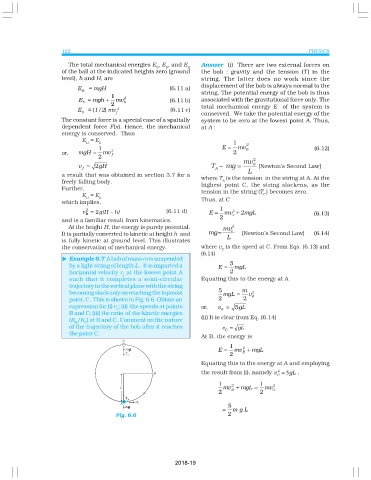
                          Example 6.7  A bob of mass m is suspended
                                                                                  5
                         t
                          by a light string of length L .  It is imparted a   E =   mgL
                          horizontal velocity v  at the lowest point A            2
                                             o
                          such that it completes a semi-circular        Equating this to the energy at A
                          trajectory in the vertical plane with the string
                                                                              5        m
                          becoming slack only on reaching the topmost           mgL =    v 2 0
                          point, C.  This is shown in Fig. 6.6. Obtain an     2        2
                          expression for (i) v ; (ii)  the speeds at points  or,  v =  5gL
                                          o                                    0
                          B and C; (iii) the ratio  of  the kinetic energies
                          (K /K ) at B and C. Comment on the nature     (ii) It is clear from Eq. (6.14)
                            B  C
                          of the trajectory of the bob after it reaches         v C  =  gL
                          the point C.
                                                                        At B, the energy is
                                                                                  1
                                                                              E =   mv +  mgL
                                                                                       2
                                                                                  2    B
                                                                        Equating this to the energy at A and employing
                                                                        the result from (i), namely v =  5 gL ,
                                                                                                   2
                                                                                                   0
                                                                              1    2         1    2
                                                                                mv +  mgL =    mv
                                                                              2    B         2   0
                                                                                  5
                                                                                =  m g L
                                          Fig. 6.6                                2


                                                               2018-19

