


Page 164 - Class-11-Physics-Part-1_Neat
P. 164
150                                                                                    PHYSICS

                       complicated trajectories. Yet, if the total external
                       force acting on the system is zero, the centre of
                       mass moves with a constant velocity, i.e., moves
                       uniformly in a straight line like a free particle.
                          The vector Eq. (7.18a) is equivalent to three
                       scalar equations,
                          P  = c , P  = c  and P  = c        (7.18 b)
                            x   1  y   2      z   3                                  (a)                       (b)
                          Here P , P  and P  are the components of the
                                 x  y     z
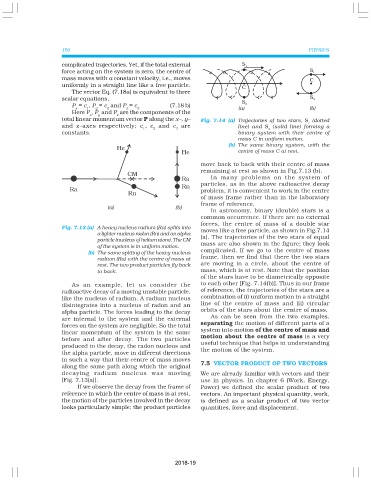
                       total linear momentum vector P along the x–, y–  Fig. 7.14 (a) Trajectories of two stars, S  (dotted
                                                                                                              1
                       and z–axes respectively; c , c    and c   are                 line) and S  (solid line) forming a
                                                    1  2       3                                2
                       constants.                                                    binary system with their centre of
                                                                                     mass C in uniform motion.
                                                                                  (b) The same binary system, with the
                                                                                     centre of mass C at rest.
                                                                        move back to back with their centre of mass
                                                                        remaining at rest as shown in Fig.7.13 (b).
                                                                            In many problems on the system of
                                                                        particles,  as in the above radioactive decay
                                                                        problem, it is convenient to work in the centre
                                                                        of mass frame rather than in the laboratory
                                                                        frame of reference.
                                       (a)                     (b)
                                                                            In astronomy, binary (double) stars is a
                                                                        common occurrence. If there are no external
                                                                        forces, the centre of mass of a double star
                       Fig. 7.13 (a) A heavy nucleus radium (Ra) splits into  moves like a free particle, as shown in Fig.7.14
                                   a lighter nucleus radon (Rn) and an alpha  (a). The trajectories of the two stars of equal
                                   particle (nucleus of helium atom). The CM
                                   of the system is in uniform motion.  mass are also shown in the figure; they look
                                                                        complicated. If we go to the centre of mass
                                (b) The same spliting of the heavy nucleus
                                   radium (Ra) with the centre of mass at  frame, then we find that there the two stars
                                   rest. The two product particles fly back  are moving in a circle, about the centre of
                                   to back.                             mass, which is at rest. Note that the position
                                                                        of the stars have to be diametrically opposite
                          As an example, let us consider the            to each other [Fig. 7.14(b)]. Thus in our frame
                       radioactive decay of a moving unstable particle,  of reference, the trajectories of the stars are a
                       like the nucleus of radium. A radium nucleus     combination of (i) uniform motion in a straight
                       disintegrates into a nucleus of radon and an     line of the centre of mass and (ii) circular
                                                                        orbits of the stars about the centre of mass.
                       alpha particle. The forces leading to the decay
                                                                            As can be seen from the two examples,
                       are internal to the system and the external
                                                                        separating the motion of different parts of a
                       forces on the system are negligible. So the total
                       linear momentum of the system is the same        system into motion of the centre of mass and
                                                                        motion about the centre of mass is a very
                       before and after decay. The two particles
                                                                        useful technique that helps in understanding
                       produced in the decay, the radon nucleus and
                                                                        the motion of the system.
                       the alpha particle, move in different directions
                       in such a way that their centre of mass moves
                                                                        7.5  VECTOR PRODUCT OF TWO VECTORS
                       along the same path along which the original
                       decaying radium nucleus was moving               We are already familiar with vectors and their
                       [Fig. 7.13(a)].                                  use in physics. In chapter 6 (Work, Energy,
                             If we observe the decay from the frame of  Power) we defined the scalar product of two
                       reference in which the centre of mass is at rest,  vectors. An important physical quantity, work,
                       the motion of the particles involved in the decay  is defined as a scalar product of two vector
                       looks particularly simple; the product particles  quantities, force and displacement.


                                                               2018-19

