


Page 183 - Class-11-Physics-Part-1_Neat
P. 183
SYSTEMS OF PARTICLES AND ROTATIONAL MOTION                                                 169

                       The angular acceleration of the engine    (1) We need to consider only those forces that
                = 4π rad/s 2                                        lie in planes perpendicular to the axis.
                   (ii) The angular displacement in time t  is      Forces which are parallel to the axis will
                given by                                            give torques perpendicular to the axis and
                                                                    need not be taken into account.
                              1
                      θ =  ω t +  α t  2                         (2) We need to consider only those components
                          0
                              2                                     of the position vectors which are
                                1                                   perpendicular to the axis. Components of
                                          2
                    =  (40π × 16 +  ×  4π × 16 )  rad               position vectors along the axis will result in
                                2
                                                                    torques perpendicular to the axis and need
                    = (640π +  512 ) rad                            not be taken into account.
                                 π
                   = 1152π rad
                                                                 Work done by a torque
                                        1152π
                Number of revolutions =        = 576      t
                                          2π
                7.12 DYNAMICS OF ROTATIONAL MOTION
                      ABOUT A FIXED AXIS
                Table 7.2 lists quantities associated with linear
                motion and their analogues in rotational motion.
                We have already compared kinematics of the
                two motions. Also, we know that in rotational
                motion moment of inertia and torque play the
                same role as mass and force respectively in
                linear motion. Given this we should be able to
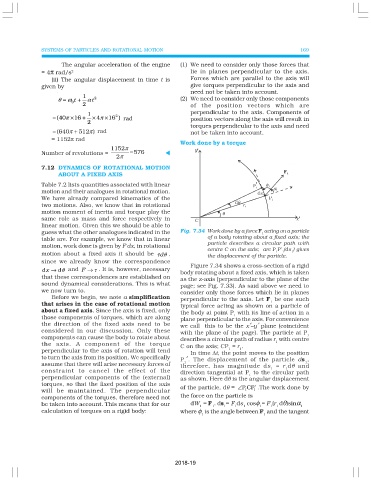
                guess what the other analogues indicated in the  Fig. 7.34 Work done by a force F acting on a particle
                                                                                              1
                table are. For example, we know that in linear            of a body rotating about a fixed axis; the
                                                                          particle describes a circular path with
                motion, work done is given by F dx, in rotational
                                                                          centre C on the axis;  arc P P′ (ds ) gives
                                                                                                     1
                                                                                                   1
                motion about a fixed axis it should be τ  dθ ,            the displacement of the particle.  1
                since we already know the correspondence
                                                                    Figure 7.34 shows a cross-section of a rigid
                dx →  dθ  and  F → τ . It is, however, necessary
                                                                 body rotating about a fixed axis, which is taken
                that these correspondences are established on
                                                                 as the z-axis (perpendicular to the plane of the
                sound dynamical considerations. This is what
                                                                 page; see Fig. 7.33). As said above we need to
                we now turn to.                                  consider only those forces which lie in planes
                   Before we begin, we note a simplification     perpendicular to the axis. Let F  be one such
                                                                                                 1
                that arises in the case of rotational motion     typical force acting as shown on a particle of
                about a fixed axis. Since the axis is fixed, only  the body at point P  with its line of action in a
                                                                                    1
                those components of torques, which are along     plane perpendicular to the axis. For convenience
                the direction of the fixed axis need to be       we call  this to be the x′–y′  plane (coincident
                considered in our discussion. Only these         with the plane of the page). The particle at P
                components can cause the body to rotate about    describes a circular path of radius r  with centre 1
                the axis. A component of the torque              C on the axis; CP  = r .          1
                                                                                  1
                                                                                      1
                perpendicular to the axis of rotation will tend     In time ∆t, the point moves to the position
                to turn the axis from its position. We specifically
                                                                 P ′. The displacement of the particle ds ,
                                                                  1
                                                                                                             1
                assume that there will arise necessary forces of  therefore, has magnitude ds      = r dθ  and
                                                                                                 1
                                                                                                      1
                constraint to cancel the effect of the           direction tangential at P  to the circular path
                                                                                         1
                perpendicular components of the (external)       as shown. Here dθ is the angular displacement
                torques, so that the fixed position of the axis  of the particle, dθ =  P CP∠  ′ .The work done by
                will be maintained. The perpendicular                                   1  1
                components of the torques, therefore need not    the force on the particle is
                be taken into account. This means that for our      dW  = F . ds = F ds  cosφ = F (r dθ)sinα 1
                                                                                                   1
                                                                                                 1
                                                                                1
                                                                            1
                                                                        1
                                                                                             1
                                                                                       1
                                                                                    1
                calculation of torques on a rigid body:          where φ  is the angle between F  and the tangent
                                                                        1                     1
                                                               2018-19

