


Page 81 - Class-11-Physics-Part-1_Neat
P. 81
MOTION IN A PLANE 67
The factor λ by which a vector A is multiplied
could be a scalar having its own physical
dimension. Then, the dimension of λ A is the
product of the dimensions of λ and A. For
example, if we multiply a constant velocity vector
by duration (of time), we get a displacement
vector.
4.4 ADDITION AND SUBTRACTION OF
VECTORS — GRAPHICAL METHOD
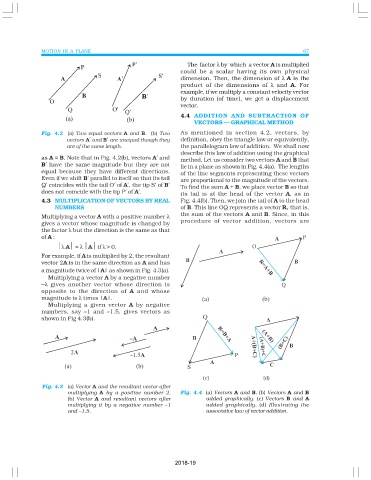
Fig. 4.2 (a) Two equal vectors A and B. (b) Two As mentioned in section 4.2, vectors, by
vectors A′ and B′ are unequal though they definition, obey the triangle law or equivalently,
are of the same length. the parallelogram law of addition. We shall now
describe this law of addition using the graphical
as A = B. Note that in Fig. 4.2(b), vectors A′ and method. Let us consider two vectors A and B that
B′ have the same magnitude but they are not lie in a plane as shown in Fig. 4.4(a). The lengths
equal because they have different directions. of the line segments representing these vectors
Even if we shift B′ parallel to itself so that its tail are proportional to the magnitude of the vectors.
Q′ coincides with the tail O′ of A′, the tip S′ of B′ To find the sum A + B, we place vector B so that
does not coincide with the tip P′ of A′. its tail is at the head of the vector A, as in
4.3 MULTIPLICATION OF VECTORS BY REAL Fig. 4.4(b). Then, we join the tail of A to the head
NUMBERS of B. This line OQ represents a vector R, that is,
Multiplying a vector A with a positive number λ the sum of the vectors A and B. Since, in this
gives a vector whose magnitude is changed by procedure of vector addition, vectors are
the factor λ but the direction is the same as that
of A :
λ A = λ A if λ > 0.
For example, if A is multiplied by 2, the resultant
vector 2A is in the same direction as A and has
a magnitude twice of |A| as shown in Fig. 4.3(a).
Multiplying a vector A by a negative number
−λ gives another vector whose direction is
opposite to the direction of A and whose
magnitude is λ times |A|.
Multiplying a given vector A by negative
numbers, say –1 and –1.5, gives vectors as
shown in Fig 4.3(b).
(c) (d)
Fig. 4.3 (a) Vector A and the resultant vector after
multiplying A by a positive number 2. Fig. 4.4 (a) Vectors A and B. (b) Vectors A and B
(b) Vector A and resultant vectors after added graphically. (c) Vectors B and A
multiplying it by a negative number –1 added graphically. (d) Illustrating the
and –1.5. associative law of vector addition.
2018-19

