Page 95 - Class-11-Physics-Part-1_Neat
P. 95
MOTION IN A PLANE                                                                           81

                              v                                             2    2  2
                     a   =      v = v /R              (4.44)               v   ω  R     2
                                     2
                       c      R                                       a =     =      = ω  R
                                                                          c
                                                                             R     R
                Thus, the acceleration of an object moving with              2
                                                                       a c  = ω  R                       (4.47)
                speed v in a circle of radius R has a magnitude
                 2
                v /R and is always directed towards the centre.
                This is why this acceleration is called centripetal  The time taken by an object to make one revolution
                acceleration (a term proposed by Newton). A      is known as its time period T and the number of
                thorough analysis of centripetal acceleration was  revolution made in one second is called its
                first published in 1673 by the Dutch scientist   frequency ν (=1/T).  However, during this time the
                Christiaan Huygens (1629-1695) but it was        distance moved by the object is s = 2πR.
                probably known to Newton also some years earlier.  Therefore, v = 2πR/T =2πRν            (4.48)
                “Centripetal” comes from a Greek term which means  In terms of frequency ν, we have
                ‘centre-seeking’.  Since v and R are constant, the     ω = 2πν
                magnitude of the centripetal acceleration is also             v = 2πRν
                constant. However, the direction changes —                   2  2
                pointing always towards the centre.  Therefore, a      a  = 4π ν R                                       (4.49)
                                                                        c
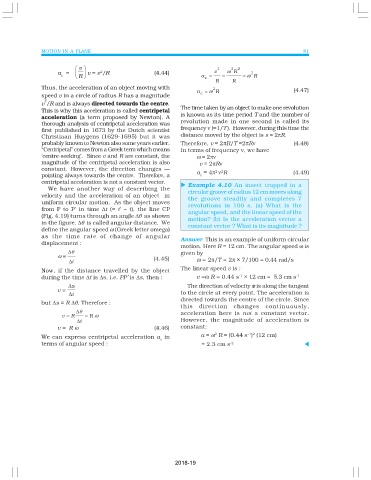
                centripetal acceleration is not a constant vector.  t  Example 4.10 An insect trapped in a
                  We have another way of describing the
                velocity and the acceleration of an object  in      circular groove of radius 12 cm moves along
                                                                    the groove steadily and completes 7
                uniform circular motion.  As the object moves
                from P to P′  in time ∆t  (=  t′  –  t), the line CP  revolutions in 100 s. (a) What is the
                (Fig. 4.19) turns through an angle ∆θ  as shown     angular speed, and the linear speed of the
                                                                    motion? (b) Is the acceleration vector a
                in the figure. ∆θ  is called angular distance.  We  constant vector ? What is its magnitude ?
                define the angular speed ω (Greek letter omega)
                as the time rate of change of angular            Answer  This is an example of uniform circular
                displacement :
                                                                 motion. Here R = 12 cm. The angular speed ω is
                         ∆ θ
                     ω =                                         given by
                         ∆t                               (4.45)       ω = 2π/T = 2π × 7/100 = 0.44 rad/s
                                                                 The linear speed v is :
                Now, if the distance travelled by the object
                                                                                      -1
                during the time ∆t is ∆s, i.e. PP′ is ∆s, then :       v =ω R = 0.44 s  × 12 cm =  5.3 cm s -1
                         ∆ s                                       The direction of velocity v is along the tangent
                     v =
                           t ∆                                   to the circle at every point. The acceleration is
                                                                 directed towards the centre of the circle. Since
                but ∆s = R ∆θ. Therefore :
                                                                 this   direction   changes    continuously,
                            ∆θ
                       v =  R  = R  ω                            acceleration here is not a constant vector.
                             t ∆                                 However, the magnitude of acceleration is
                     v =  R ω                           (4.46)   constant:
                                                                             2
                                                                                         –1 2
                We can express centripetal acceleration a  in           a = ω  R = (0.44 s )  (12 cm)
                                                          c
                terms of angular speed :                                    = 2.3 cm s -2                    t


                                                               2018-19
   90   91   92   93   94   95   96   97   98   99   100