


Page 91 - Class-11-Physics-Part-1_Neat
P. 91
MOTION IN A PLANE                                                                           77

                  This relative velocity vector as shown in
                Fig. 4.16 makes an angle θ  with the vertical. It is
                given by
                              v    12
                       tan θ =  b  =  =  0.343
                              v    35
                               r
                Or,
                          θ ≅ 19
                  Therefore, the woman should hold her
                umbrella at an angle of about 19° with the
                vertical towards the west.
                Note carefully the difference between this
                Example and the Example 4.1. In Example 4.1,
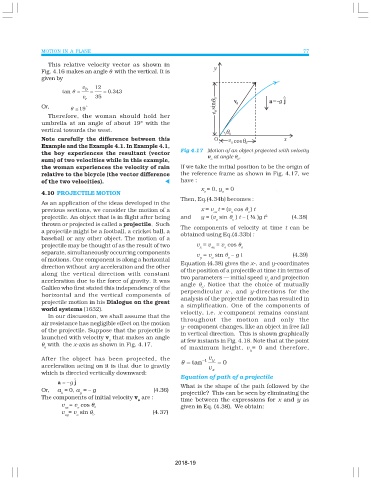
                                                                 Fig 4.17   Motion of an object projected with velocity
                the boy experiences the resultant (vector
                                                                           v  at angle θ .
                sum) of two velocities while in this example,               o        0
                the woman experiences the velocity of rain       If we take the initial position to be the origin of
                relative to the bicycle (the vector difference   the reference frame as shown in Fig. 4.17, we
                of the two velocities).                    t     have :
                                                                        x = 0, y  = 0
                4.10  PROJECTILE MOTION                                  o      o
                                                                 Then, Eq.(4.34b) becomes :
                As an application of the ideas developed in the
                previous sections, we consider the motion of a          x = v t = (v  cos θ ) t
                                                                             ox
                                                                                         o
                                                                                   o
                projectile. An object that is in flight after being  and  y = (v  sin θ  ) t – ( ½ )g t 2        (4.38)
                                                                             o     o
                thrown or projected is called a projectile.  Such
                                                                 The components of velocity at time t can be
                a projectile might be a football, a cricket ball, a
                                                                 obtained using Eq.(4.33b) :
                baseball or any other object. The motion of a
                projectile may be thought of as the result of two      v  = v  = v  cos θ o
                                                                                o
                                                                        x
                                                                            ox
                separate, simultaneously occurring components
                                                                       v = v  sin θ  – g t               (4.39)
                                                                        y
                of motions. One component is along a horizontal             o     o
                                                                 Equation (4.38) gives the x-, and y-coordinates
                direction without  any acceleration and the other  of the position of a projectile at time t in terms of
                along the vertical direction with constant
                                                                 two parameters — initial speed v  and projection
                acceleration due to the force of gravity. It was  angle θ . Notice that the choice of mutually
                                                                                                o
                Galileo who first stated this independency of the       o
                                                                 perpendicular x-, and y-directions for the
                horizontal and the vertical components of        analysis of the projectile motion has resulted in
                projectile motion in his Dialogue on the great   a simplification. One of the components of
                world systems (1632).
                                                                 velocity, i.e. x-component remains constant
                  In our discussion, we shall assume that the    throughout the motion and only the
                air resistance has negligible effect on the motion
                                                                 y- component changes, like an object in free fall
                of the projectile. Suppose that the projectile is
                                                                 in vertical direction.  This is shown graphically
                launched with velocity v  that makes an angle
                                        o                        at few instants in Fig. 4.18. Note that at the point
                θ  with  the x-axis as shown in Fig. 4.17.
                 o                                               of maximum height, v = 0 and therefore,
                                                                                          y
                After the object has been projected, the         θ = tan −1  v y  = 0
                acceleration acting on it is that due to gravity           v x
                which is directed vertically downward:
                                                                 Equation of path of a projectile
                     a = −g    j
                                                                 What is the shape of the path followed by the
                Or,  a  = 0, a  = – g                  (4.36)
                       x     y                                   projectile?  This can be seen by eliminating the
                The components of initial velocity v  are :      time between the expressions for x  and y as
                                                  o
                       v = v  cos θ o                            given in Eq. (4.38).  We obtain:
                        ox
                            o
                       v = v  sin θ                       (4.37)
                        oy  o     o
                                                               2018-19

